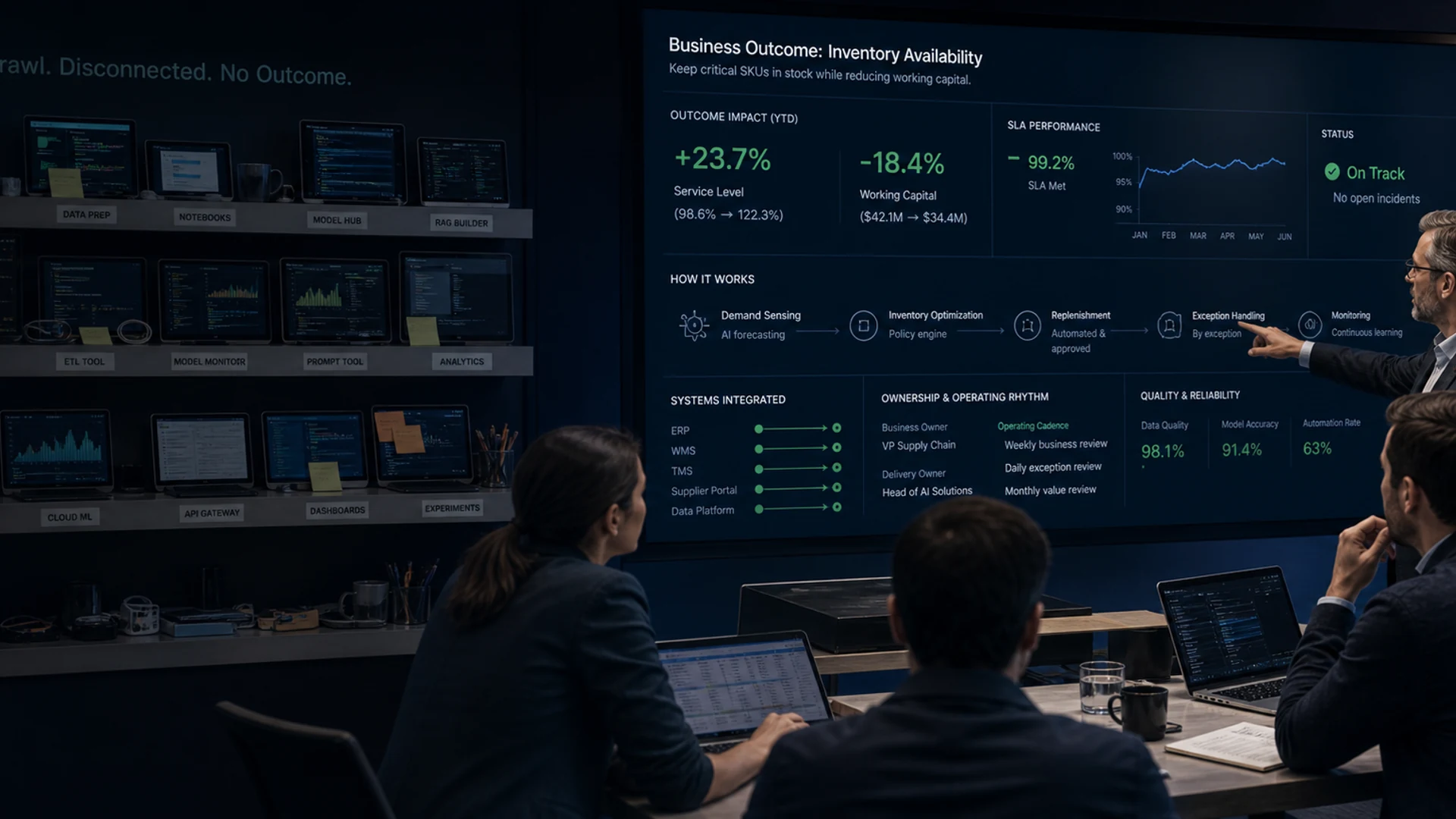
Two AI services firms pitch the same prospect. The first describes their stack: they deploy RAG pipelines using a specific retrieval framework, connect agents to CRMs via a specific orchestration layer, automate workflows using a specific tool. The pitch is technically credible. The deliverable is clear: a working implementation, handed over at project close.
The second firm opens differently. They describe a specific type of problem in the prospect’s industry: a process that currently requires senior analyst time to produce an output that could be automated, with an identifiable cost, a measurable baseline, and a clear success metric. They describe what they delivered for a prior client with the same problem. They describe how they would measure success for this one.
The first firm wins on price. The second firm wins on value. Over three years, the second firm has a reference client, a proven playbook, and a retainer. The first firm is pitching its fifteenth new implementation.
The Tool Vendor Trap
The AI services market in 2026 is crowded with firms that sell implementations. Set up your RAG pipeline. Connect your agents to your CRM. Automate this workflow. Build this integration.
The tool vendor trap is structural. When the implementation is complete, the engagement ends. The vendor’s revenue depends on starting the next implementation. The client’s value depends on the system continuing to work. These interests diverge at delivery.
The tool vendor is rewarded for a working system at handover, not for whether that system produces business results in month six. This is not a character failure. It is a commercial model that does not align the vendor’s incentives with the client’s actual needs. The vendor has every reason to build something clean and well-documented, and no structural reason to concern themselves with what happens to it after the handover call.
The firms that will own the AI services market are not the ones with the longest tool list or the fastest deployment time. They are the ones who tied their revenue to whether the output actually changed the business. Not because that is a more virtuous model, but because it is a more defensible one.
A tool implementation is replicable. Any competent firm can build a RAG pipeline. The gap in implementation quality between good firms and mediocre ones is narrow, and it narrows further as tooling matures. Outcome delivery requires domain knowledge, measurement discipline, and production experience that take years to accumulate. That gap does not narrow when better tools become available.
What Outcome-Based AI Actually Means
Outcome-based selling is not taking on unlimited risk for client results that depend on factors outside the engagement. That is a different, much worse model.
It means: defining success in business terms before the first line of code, instrumenting the system to measure those terms, reporting on them monthly, and structuring the ongoing relationship around whether the metrics are moving.
The difference between a tool vendor and an outcome partner is visible in how each describes a delivery.
A tool vendor: “We built a RAG system that answers customer support queries using your knowledge base.”
An outcome partner: “Customer support ticket volume for the query category we targeted decreased by a measurable amount within ninety days of deployment. Here is the baseline, the measurement methodology we agreed before the project, and the current number.”
The measurement requirement is non-negotiable. Outcome-based selling only works if success is measurable, the baseline is documented before the project starts, the measurement methodology is agreed before the project starts, and both parties accept the metric as the arbiter of success. Without those four conditions, the “outcome” is whatever the client feels at the end.
This means outcome-based AI delivery requires a different kind of client than tool-based delivery requires. Not every client qualifies.
The Business DNA Problem
AI agencies that start as services businesses face a structural ceiling. Revenue scales with headcount and hours. Growth requires hiring before the revenue exists to fund it. The exit paths are productizing the service or growing the team.
Productizing the service means accumulating reusable assets: playbooks for known problem types, evaluation frameworks for specific domains, agent architectures that solve a class of problem rather than a specific instance, integration templates for common enterprise systems. The assets reduce per-client effort for solving problems the firm has solved before, which improves margins and delivery quality simultaneously.
The business DNA question is whether the organization is designed to accumulate these assets or to start each engagement from scratch. Tool vendors tend to customize each implementation to the client’s specific tool stack. The customization is a service differentiator in the short term and a scaling barrier in the long term, because nothing compounds. Each project is a one-time effort.
Outcome partners accumulate a library of validated solutions for known problem types. The tenth client who needs a document review automation for a specific document class in a specific regulatory environment benefits from nine prior calibrations. The system is better out of the gate. The delivery is faster. The risk estimate is more accurate. The edge cases have been encountered before.
This is the compounding advantage that separates firms building durable businesses from firms building a pipeline of implementations. The implementations generate revenue. The accumulation of reusable assets is what converts revenue into a business that improves over time.
The Client Selection Discipline
Outcome-based models require clients whose outcomes are measurable, attributable, and within the scope of what the AI system can actually influence.
Some clients are structured in ways that make outcome measurement impossible. Success defined by executive perception rather than metrics. Internal processes that change so frequently that no baseline survives long enough to compare against. Organizations where the AI system is one of many simultaneous changes, making attribution impossible. These are not bad clients for a competent AI firm. They are bad clients for an outcome-based model. A tool vendor can serve them fine.
Good clients for outcome models have specific, quantifiable operational problems. A process with a cost, a volume, and an error rate that can be measured before and after. A stable enough environment to establish a meaningful baseline. A decision owner who will act on the metrics rather than deferring to executive opinion. A culture that accepts that early numbers may be unflattering while the system is being calibrated.
The qualification question that separates outcome clients from tool clients is worth asking directly in the first substantive conversation: “If we showed you at month three that the system is not performing against the agreed metric, what would you do?”
A client oriented toward outcomes says: “Let’s understand why and fix it.”
A client oriented toward deliverables says: “That’s the system we agreed to build.”
The second answer is not wrong. It is the answer of a client who is buying a tool. Selling that client a managed service with outcome accountability is selling the wrong model to the right buyer.
The Managed Service That Scales
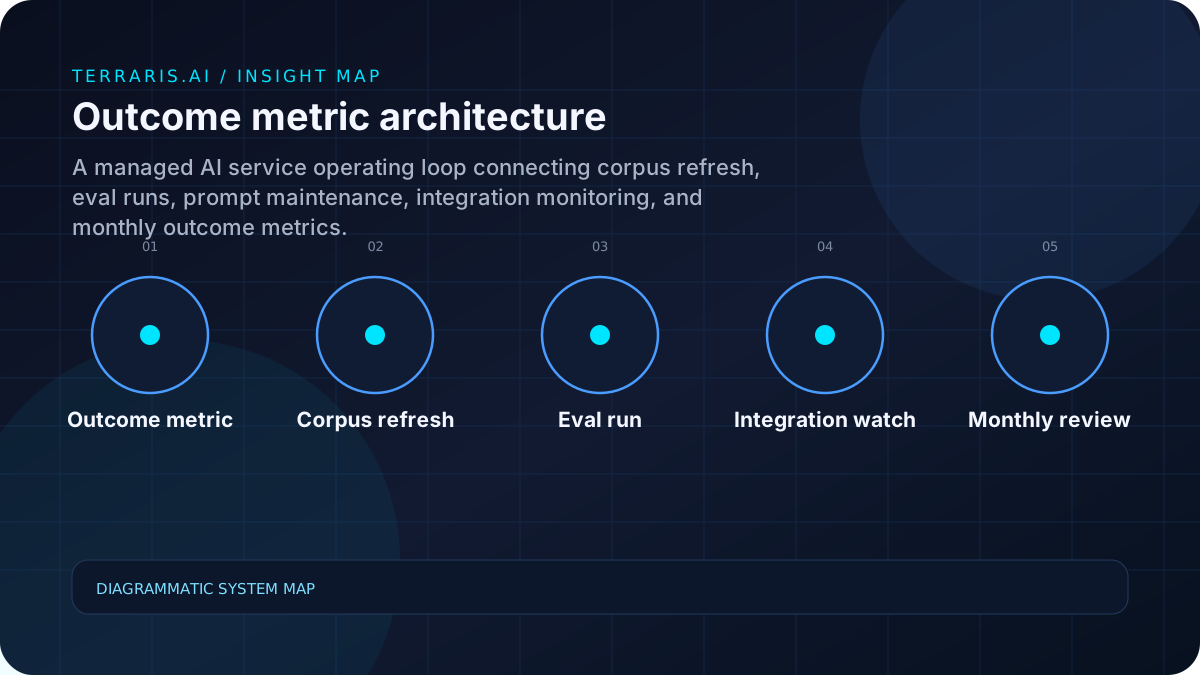
The outcome model requires ongoing operation. Delivering an outcome metric in month one and then handing over the system does not produce a managed service. It produces a well-launched tool.
A managed AI service means the vendor operates the system, not just builds it. Corpus refresh: new documents ingested, stale documents flagged. Prompt maintenance: updates for model changes and emerging edge cases. Evaluation harness runs: RAGAS scores compared against baseline with regressions investigated. Integration monitoring: connected systems verified against expected schemas. Improvement sprints: one new capability or one significant quality improvement per month from the prioritized backlog.
This model scales differently from implementation work. Implementation revenue ends at delivery. Managed service revenue is recurring, and it compounds with the maturity of the system. The same team accumulates expertise in a specific client’s domain, data, and edge cases that makes each subsequent improvement faster and more accurate. The managed service that has been running for two years is more valuable to the client and more profitable for the vendor than it was in month one, without requiring proportional growth in headcount.
Pricing for managed AI service is structured as a fraction of the value it generates, with a floor covering minimum operational cost and a ceiling reflecting a maximum reasonable fraction of the value the system creates. The economics are defensible because they are anchored to the value estimate from discovery. The client is paying a fraction of what the system is saving or generating. Both parties can see the math.
The operational discipline required is non-negotiable. A managed service without defined SLAs, a quality reporting cadence, an escalation path, and a governance structure is a support contract priced too high. The discipline is what converts operational work into client confidence, and client confidence is what produces contract renewals.
The Positioning That Survives Commoditization
Tool implementation will commoditize. The tools themselves are becoming easier to deploy. The frameworks are better documented. The number of competent engineers who can set up a RAG pipeline is growing rapidly. The implementation margin will compress.
The positioning that survives commoditization is not built on tool expertise. It is built on four things that cannot be purchased from a tool vendor or replicated by hiring engineers.
Domain expertise: deep knowledge of a specific industry’s processes, data structures, regulatory environment, and failure modes. The kind of knowledge that comes from deploying production systems in a specific domain over years, not from reading industry reports.
Outcome track record: documented, referenceable results from previous engagements in the same domain. Not a portfolio of implementations. A portfolio of measurable improvements with named metrics and named clients willing to discuss the results.
Governance capability: the ability to deploy AI in regulated environments with audit trails, human review gates, permission models, and compliance documentation. In financial services, healthcare, legal, and public sector contexts, governance capability is not a differentiator. It is the minimum required to be considered.
Integration depth: embedded in clients’ actual operational systems, not sitting alongside them as a standalone tool. Integration depth creates switching costs that are earned through investment, not contractual lock-in. A client whose AI system is embedded in their core operational workflow, and whose corpus and evaluation harness represent years of accumulated calibration, has built something that is difficult and expensive to replace.
None of these can be acquired quickly. They are accumulated through production deployments in a specific domain over time. The implication for positioning is to choose the domain now, accumulate the track record, and build the managed service capability before the market decides that tool implementation is a commodity.
The commodity market will exist. It will be large. It will not be where the durable AI services businesses are built.
Terraris.ai focuses on regulated enterprise deployments where governance, domain expertise, and ongoing operation matter more than implementation speed. If that is the context you are navigating, start with a discovery conversation.