

Every enterprise AI initiative eventually hits the same wall. The model works fine in the demo. It answers questions, drafts documents, classifies inputs. Then someone asks it something that requires knowing what your company actually does, and it responds with the confident vagueness of a very well-read stranger who has never worked there.
The diagnosis is almost always the same: the data was not ready. The corporate context was locked in a CRM nobody can query, scattered across PDFs from 2019, fragmented across systems that do not talk to each other, or owned by a vendor whose export format is unusable. The model did not fail. The data architecture failed.
This is the wall most AI-First strategies hit, and it hits later than it should, because the wall was visible from the beginning. Companies bought GPT-4o access, deployed a chatbot, and told themselves the data problems would be solved later. Later arrived. The data problems were not solved. The initiative stalled.
The Uncomfortable Truth About AI-First Stalls
The model is commoditizing fast. GPT-4o, Claude, Gemini, Llama. The frontier advances every six months, capabilities that required a leading model last year run on a mid-tier model today, and the cost per token continues to drop. In that environment, the model selection is almost never the strategic question.
The proprietary data corpus is the strategic question. The company that has structured, curated, and made queryable its internal knowledge, its historical decisions, its client records, its process documentation, its institutional memory, is the company that builds AI systems that actually work in production. Not because they have a better model. Because the model has better inputs.
The contrarian framing that practitioners often resist: the company that masters data iteration is the AI-First company, regardless of which LLM they use. Two companies can license the same model. The one with the better data architecture wins every time.
Software 2.0 and the Data Engine Paradigm
Andrej Karpathy introduced a framework that reorients how to think about AI system development. In Software 1.0, you write explicit instructions: if this, do that. In Software 2.0, you program the system by choosing a dataset, a loss function, an architecture, and a training process. The neural network learns the behavior from examples rather than following rules you wrote.
The enterprise implication is not immediately obvious, but it is profound. If the system learns from data, then the data is the program. Improving the data is improving the system. Curating the dataset is doing development work. And maintaining the feedback loop between production outputs and training inputs is the core operational discipline.
Karpathy calls this the data engine: the metabolic loop that keeps an AI system improving in production rather than degrading. Train, deploy, observe failures, mine rare cases, rebuild ground truth, clean the dataset, retrain, redeploy. Repeat.
Three rules govern the data the engine runs on: it needs to be big enough to cover the distribution of real inputs, it needs to be correct, meaning the labels and examples accurately reflect ground truth, and it needs to be diverse, meaning it covers the edge cases and not just the common cases. Not just big. Correct and diverse.
For an enterprise deploying AI in production, this translates to an operational question: who runs the data engine? Who owns the feedback loop? Because without someone explicitly responsible for that function, the AI system that works on launch day will be a worse system six months later. The world changes. The data does not.
What a Production AI Data Loop Looks Like
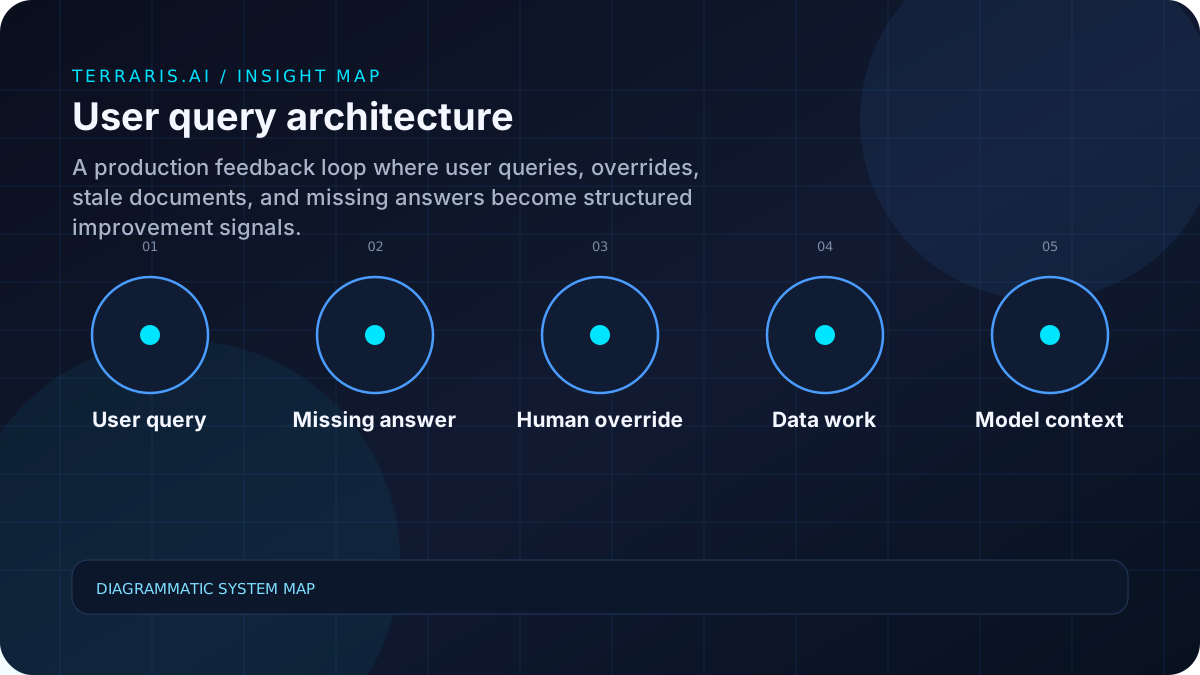
Abstract principles land differently when applied to specific system types. Three examples from common enterprise deployments.
A support agent that handles customer inquiries generates a data loop by capturing: queries it answered poorly, cases where a human overrode its response, documents it cited that turned out to be outdated, and questions it could not answer because the relevant policy or product information did not exist in its context. Each of these is a label for an improvement. None of them happens automatically. Someone has to build the capture mechanism, review the cases, and feed the corrections back into the system.
A RAG system for internal knowledge retrieval generates a data loop by logging: which sources were used to answer a query, whether the user found the answer useful, which queries returned no reliable context, and which citations were rejected by users as incorrect or irrelevant. Without this logging, the system operates in the dark. You cannot improve what you cannot observe.
A commercial automation tool that handles lead qualification or proposal generation generates a data loop by keeping examples of: misclassified leads that later converted or churned unexpectedly, objection patterns that emerged after the system was trained, and responses that generated legal or reputational risk. These are the edge cases that erode system performance over time if nobody is paying attention.
Karpathy’s warning about product development that lacks an iterative loop is worth taking seriously: the product cannot be useless until the day it suddenly works completely. Enterprises that treat AI system deployment as a completion rather than an operation start are making that error. Every failure in production is raw material for improvement. Without a data loop, those failures just accumulate.
The Context Architecture Question Before the Model Question
Corporate context is what transforms a generic language model into an actually useful enterprise system. The distinction is not marginal. It is the difference between a system that answers from public internet training and one that answers from the specific documents, contracts, policies, win-loss history, and regulatory guidance that define how this company operates.
Without context architecture, the company is paying API fees for a very expensive version of what any employee could already access through a search engine. That is not AI-First. It is expensive prompting, and the spec in the title was chosen deliberately.
The context inventory that every implementation should begin with: where is the information the AI system needs to answer its intended queries, who has permission to access it, which of those queries drive action rather than just information, which actions require human approval before execution, and how will the response be audited for accuracy over time.
Each of those questions has an organizational answer, not a technology answer. The technology implements the answer. But the answer has to exist first. This is why AI discovery sprints must surface the data and context questions, not just the process questions. A well-mapped process with poorly understood context architecture will produce a system that maps the process correctly but answers incorrectly.
Three Data Failure Modes That Kill AI Projects
The three failure modes appear in a consistent sequence, and each has a different fix.
Data exists but is inaccessible. The information is somewhere in the organization, but it lives in a vendor system with a restrictive export policy, in PDFs that were never indexed, in a legacy database that requires a specialist to query, or in email threads that nobody archived systematically. The fix is data infrastructure work before AI work. There is no shortcut.
Data exists and is accessible but is not curated. Inconsistent labels, outdated records, conflicting entries, missing ownership, no ground truth established. The model trains on noise. The outputs reflect the noise. Garbage in, garbage out is not a dated concept. It is the central operational reality of ML systems.
Data exists, is accessible, and is initially curated, but nobody owns quality over time. This is the failure mode that appears in year two rather than year one. The system was good at launch. Then the business changed, new products were released, policies were updated, personnel turned over, and nobody updated the data the system depends on. No one reviews the system’s outputs for degradation. No one closes the feedback loop. The system becomes progressively less useful without any visible incident to attribute the decline to.
None of these failure modes is solved by buying a better model. Each requires a different operational response.
The Roadmap Resequencing That Changes Everything
The standard roadmap for enterprise AI projects: model selection, vendor negotiation, integration architecture, implementation, user training, deployment. Data is addressed somewhere in the middle, as an integration task rather than a foundational question.
The correct sequence runs differently: process map, data audit, ground truth definition, eval harness construction, model selection for the specific task, narrow pilot with real metrics, data loop implementation, then and only then a retainer model for ongoing improvement. Model selection comes fifth. Eval harness comes fourth. Data work comes second.
The companies that observers in the market describe as successfully AI-First in 2026 are the ones that started with the boring-looking data work. Cleaning records, documenting processes, establishing data ownership, building logging infrastructure. None of this generated press releases. All of it created the substrate on which working AI systems run.
The competitors who announced AI-First strategies in 2024 with launches and partnerships are largely in a pattern of “addressing data quality issues” now [HIPÓTESE: observed pattern, not external statistic]. The ones who started with data are in production. The irony of the AI-First moment is that the companies who looked slowest at the start, the ones investing in data infrastructure rather than demo-ready chatbots, are the ones with real capability today.
The data and context architecture questions are part of every AI Opportunity Sprint we run. The sprint surfaces where your data is actually available, accessible, and curated before any build scope is defined.