Most teams using Claude Code are using it as fast autocomplete. They accept suggestions, reject the bad ones, move on. The result is a marginal productivity gain in code generation, no change in time-to-production, and the same debugging surface they had before.
The teams that are actually shipping faster are doing something different. They are not using Claude Code as a suggestion engine. They are using it as a delivery environment: spec, context, tools, tests, and governance built into the project structure. The distinction is not a configuration option. It is a fundamentally different understanding of what the tool is for.
Autocomplete solves the typing problem. A delivery system solves the specification-to-production problem. The first is faster. The second is worth building around.
The Autocomplete Trap
The autocomplete mental model is intuitive because it matches how AI coding tools were introduced. Tab to accept. Escape to reject. Repeat until the function is done.
This model captures a real value: it reduces keystrokes on patterns you already know. But it leaves the hard parts of software delivery untouched. The ambiguous requirements. The architectural choices that seem small and turn out not to be. The test coverage that gets skipped because the code looked right. The deployment that fails because someone forgot an environment variable.
A delivery system addresses all of these, not just the typing.
The WAT Framework
The structure that turns Claude Code into a delivery environment has three components: Workflows, Agent, and Tools.
Workflows are markdown files that describe processes in natural language, readable by humans and by the agent. They live in the repository and are versioned with the code. A workflow file might define how to set up a new service, how to structure a pull request description, or how to run the pre-deployment checklist. These are not scripts. They are documented knowledge that the agent can follow and that a new team member can read.
Agent is Claude Code operating within the project context. That context is defined by a CLAUDE.md file, the workflow files, and the explicit tool permissions granted to the agent. A CLAUDE.md with clear behavior rules, naming conventions, test requirements, and security constraints produces a materially different agent than a bare repository. The agent’s behavior is a function of the context it operates in.
Tools are the scripts, APIs, integrations, and functions the agent can call. The rule for tools is that they are tested independently before the agent uses them. An agent calling a broken tool does not debug the tool; it works around it in ways that are hard to trace. Every tool must work correctly before it enters the agent’s scope.
The critical insight is that the project does not live in the chat. It lives in files. A CLAUDE.md, workflow files, and tool definitions accumulate organizational learning that persists across sessions, across team members, and across the tenure of any individual engineer. That accumulated context is the compound value of a delivery system over an autocomplete tool.
The Five Movements of AI-Assisted Delivery
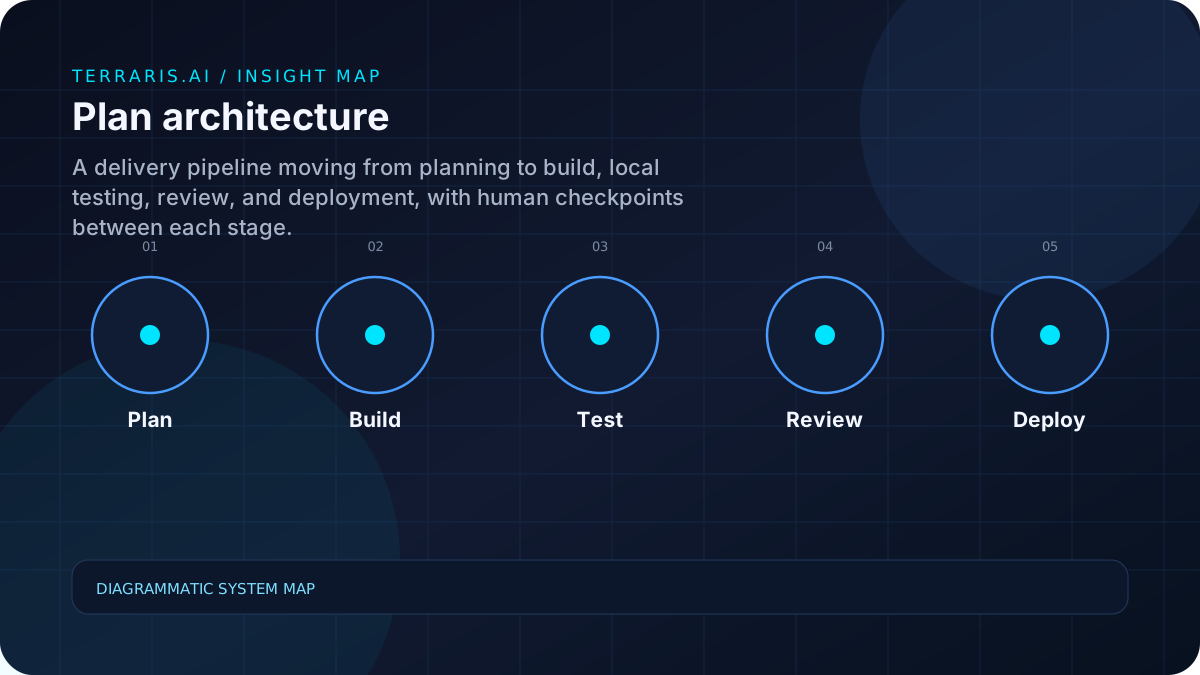
A delivery system structures work into movements, each with a human checkpoint between them.
The first movement is planning. The agent reads the spec, surfaces its assumptions, asks clarifying questions, and produces an explicit plan before writing a line of code. This is not optional ceremony. It is the moment that prevents hours of work based on a misread requirement.
The second movement is building. The agent implements in a worktree or isolated branch, not on main. Changes are isolatable. The diff is visible before any human review.
The third movement is local testing. The agent runs the test suite, lints, and static analysis. Failures are diagnosed and fixed before the code reaches a human reviewer. The agent does not declare a task complete because the code compiles.
The fourth movement is publishing. A human reviews the pull request. The agent addresses review comments. CI passes before merge. The agent is not autonomous at this gate.
The fifth movement is monitoring. Production logs, alerts, and error rates are observed. The agent assists with debugging but does not auto-patch production. Production is not a continuation of the build loop.
Each movement accelerates with agent assistance. The human’s role is to gate the transitions between them, not to supervise every line within them.
GStack: The Agentive Engineering Team Pattern
The GStack pattern, shared by Garry Tan [unverified: current repository stats at time of publish], makes the five-movement structure concrete by assigning each movement a named phase with explicit entry and exit criteria.
The sequence starts with office hours: prove the problem exists before writing code. What is the failure mode being addressed? Does the existing system actually exhibit it?
Adversarial review follows: identify risks before implementation. A second perspective, before investment is made, on what could go wrong.
Design shotgun: generate three to five architectural alternatives before committing to one. The cheapest architectural decision is the one made before any code exists.
Implementation in worktree: isolated branch, independently testable. The diff is clean because nothing adjacent was touched.
Browser QA: the agent runs visual and functional checks against the expected behavior. Not a substitute for human QA, but a first filter that catches regressions before they become a human’s problem.
Ship check: a pre-deployment checklist that includes security review, environment variables, rollback plan, and observability confirmation.
The productivity gain from GStack is not from removing these phases. It is from compressing them while maintaining their function. A ship check that used to take a day takes an hour when the agent drives it.
Skills and Context as Accumulated Capital
Skills are reusable workflows encoded as custom slash commands. Each skill represents team knowledge: how to set up a new service, how to run the deploy checklist, how to structure a PR description that a reviewer can act on.
A skill debugged once is reusable across sessions and across team members. The engineer who built the deploy checklist skill is no longer the bottleneck for running it correctly.
The compound effect is structural. A codebase with a CLAUDE.md, a set of workflow files, and a library of working skills is worth more than a bare codebase. The AI gets smarter about your specific context over time, not because the model changes, but because the context it operates in accumulates precision.
This is the wiki principle applied to code: every bug fixed should improve the next session, not just resolve the current one. The fix goes into a test. The pattern behind the fix goes into a workflow. The workflow eventually becomes a skill.
What Does Not Change
A delivery system does not change what makes software good. Code still needs to be correct, secure, maintainable, and observable. A faster path from specification to running code is not the same as a shorter path to working software.
The delivery system raises the floor: faster prototyping, more consistent style, fewer typos, more disciplined PR descriptions. It does not automatically raise the ceiling.
The teams that win with AI-assisted delivery are not the ones who automate the most typing. They are the ones who use the time saved to invest in specification quality, test coverage, and architectural discipline. The agent compresses the cost of implementing a good spec. It does not generate the good spec.
There is a pattern worth naming: AI coding agents are uneven. They handle patterns they have seen at high reliability and fail unpredictably on novel domains, security edge cases, and performance characteristics at scale. The human engineer’s job shifts from writing to specifying, reviewing, and knowing when to override.
The delivery system is the structure that makes the agent’s speed an asset rather than a liability.
Implementing a delivery system rather than an autocomplete setup? Start with CLAUDE.md: define behavior rules, naming conventions, and test requirements before the first agent session. The context you build there is the capital the system compounds on.
Related: The Four Guardrails That Separate AI Coding from AI Shipping and Vibe Coding Is a Prototype Strategy, Not a Production Strategy