
Enterprise AI deals in 2026 stall on procurement review, not on demos. The demo impresses. Then the procurement committee meets and asks three questions: who is liable when the agent is wrong, what data does the system touch and where does it go, and where is the audit trail.
Vendors who cannot answer these questions cleanly lose to vendors who can. Not on price. Not on capability. On governance.
The companies treating the EU AI Act as a compliance burden are reading the regulation through the wrong lens. It is not a cost. It is a moat, available to whoever builds it first.
The Procurement Committee Reality
Enterprise software procurement in regulated industries follows a predictable pattern: technical evaluation, security review, legal and compliance review, then decision. The first two stages have accelerated because cloud infrastructure has made security defaults better and technical evaluation shorter. The third stage has not accelerated. It has gotten harder.
Legal teams are asking about AI liability in contracts where they were not asking two years ago. IT security teams are classifying AI vendors under new risk tiers. Compliance officers are asking questions about data residency and model training that most AI vendors have not prepared for.
The vendor who walks into that conversation with EU AI Act documentation, ISO 42001 certification progress, and a clear risk classification for the system being sold, converts deals that governance-unprepared competitors lose. Not because the procurement committee loves compliance. Because the procurement committee is trying to manage risk, and governance documentation reduces their risk surface.
This is not a defensive position. It is a differentiated commercial offer in a market where most competitors have not yet built it.
What the EU AI Act Actually Requires
The EU AI Act classifies AI systems into four risk tiers, each with different obligations.
Unacceptable risk: prohibited uses, including social scoring by public authorities, real-time biometric surveillance in public spaces, and systems that exploit vulnerabilities of specific groups. Nothing relevant to standard enterprise AI deployments.
High risk: the category where compliance obligations concentrate. High-risk applications include AI systems that make or assist consequential decisions in employment, education access, credit, healthcare, critical infrastructure management, and law enforcement. For each high-risk system, the EU AI Act requires: conformity assessment before deployment, detailed technical documentation, registration in an EU database, mandatory human oversight mechanisms, post-market monitoring, and incident reporting to regulators.
Limited risk: transparency obligations apply. Users must be informed when they are interacting with an AI system. Chatbots, AI-generated content, deep fakes, and similar applications sit here.
Minimal risk: no mandatory requirements. Most AI tools used in standard business operations fall here.
The practical question for any enterprise deploying AI is: where does each system we use or develop sit in this classification? The answer is not always obvious, and getting it wrong in either direction creates problems. Classifying a high-risk system as minimal risk creates regulatory exposure. Over-classifying creates unnecessary compliance overhead.
A discovery process that maps AI systems to risk tiers, before implementation, is the governance work that makes everything else tractable.
ISO 42001 — The Management System Layer
ISO 42001:2023 is the AI management system standard. Its closest analogue in enterprise software procurement is ISO 27001 for information security. Published in November 2023, certifiable via third-party audit, and designed to apply to any organization that develops, provides, or uses AI systems.
The standard covers six key domains: leadership and AI governance policy, risk assessment and treatment, data governance specific to AI, transparency and explainability requirements, human oversight mechanisms, and incident management for AI failures. It is technology-agnostic. It governs how you manage the AI you use, not the specific technical implementation.
Why this matters commercially: ISO 27001 changed enterprise software sales. Customers began requiring it in RFPs, then in standard vendor agreements, then as a baseline expectation rather than a differentiator. ISO 42001 is following the same adoption curve for AI. It is not yet universal, but the leading edge of enterprise procurement is already asking for it.
The company that certifies in 2026 can put ISO 42001 on every proposal. The company that waits until 2028 because nobody required it yet will be catching up to peers who were early. The window for being a visible early mover on AI governance certification is closing over the next 12 to 18 months.
The EU AI Act connection is also material. ISO 42001 certification provides documentation and process evidence that supports conformity assessment for high-risk AI systems under the Act. Not a substitute for EU AI Act compliance, but a significant structural accelerator that reduces the gap analysis and documentation work for companies already pursuing certification.
Shadow AI as the Real Risk Vector
The governance gap that most enterprises underestimate is not in the AI systems the CTO approved. It is in the ones nobody approved.
Shadow AI: employees using public LLMs, typically ChatGPT or Gemini on free or personal tiers, with corporate data, without IT awareness or policy coverage. Client proposals being drafted with confidential deal information pasted into a public model. Competitive analysis being done with internal strategy documents as context. HR processes being managed with personal data that is GDPR-scoped.
The EU AI Act exposure created by Shadow AI use is material and often invisible. If employees are using a public AI system to make or assist employment decisions, credit decisions, or other high-risk determinations, the company may be operating as an EU AI Act provider or deployer without any awareness that they have obligations.
The GDPR exposure is more familiar but still frequently underestimated: personal data submitted to public LLMs may be retained and used for model training depending on the provider’s terms of service and the tier being used. The default assumption that “it’s just a chat tool” is not a defensible position in a data breach investigation.
Shadow AI mapping, covered in more depth in the companion article on shadow AI governance, is not optional in a comprehensive governance posture. It belongs in any discovery process that is serious about compliance.
The Governance-First Commercial Pitch
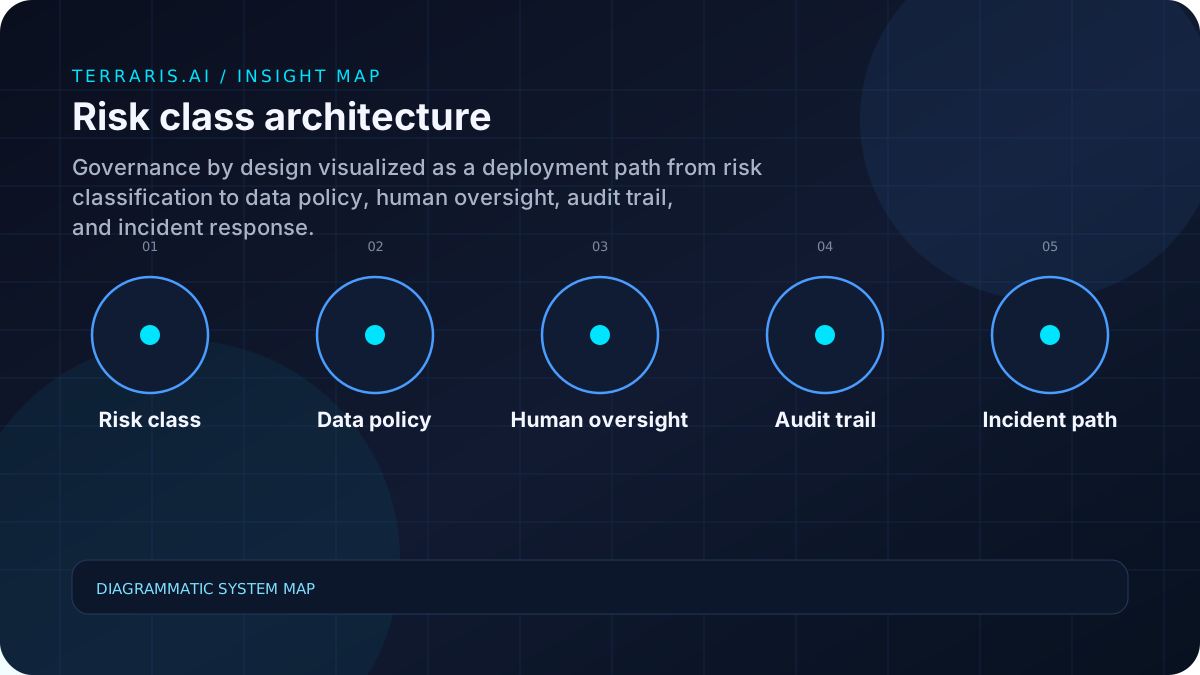
The positioning for a governance-first AI implementation partner is narrow and defensible: “We implement AI with governance by design, not governance as retrofit.”
In practice, governance by design means: risk classification during discovery rather than after deployment, data access policies defined before build scope is set, human-in-the-loop mechanisms for high-stakes actions built as system requirements rather than added after incidents, audit trails as a standard output of every production system, and an incident response plan in place before go-live.
This is not slower than ungoverned implementation. The comparison baseline is wrong. The relevant comparison is not “governed implementation versus ungoverned implementation over the first 90 days.” The relevant comparison is “governed implementation over 12 months versus ungoverned implementation over 12 months, including the cost of the governance event that the ungoverned approach was building toward.”
The legal and reputational costs of an ungoverned AI system that makes a consequential error in a regulated context, handles personal data inappropriately, or generates output that creates liability, are not theoretical. They are the actual costs the governance work prevents.
Boutique firms doing governance-first AI implementation are rare in this market. Most system integrators treat governance as a checkbox: a compliance section in the project plan that gets minimal attention until something goes wrong. That gap is the commercial opportunity.
The NIST AI RMF Connection
For companies with US federal procurement aspirations or US operations, NIST AI RMF alignment operates as a parallel requirement to EU AI Act and ISO 42001 compliance.
The NIST AI Risk Management Framework, published by the US National Institute of Standards and Technology, organizes AI risk management around four core functions: Govern, Map, Measure, and Manage. The Govern function covers organizational policies, roles, and culture around AI risk. Map covers the risk identification and classification work. Measure covers the testing and evaluation of identified risks. Manage covers the response, recovery, and improvement processes.
The practical intersection for European companies: EU AI Act compliance with ISO 42001 as the management system creates significant overlap with NIST AI RMF requirements. A company that has done the work for both EU and NIST frameworks is positioned for cross-regulatory enterprise procurement. In 2026, that means European companies selling into US federal supply chains, financial services, healthcare, and other regulated sectors where NIST guidance influences procurement.
Enterprise AI procurement is bought by committee. The committee includes legal, IT security, compliance, procurement, and technical evaluation. Governance documentation is the tiebreaker when capabilities are comparable, which they increasingly are. The companies that prepared for this moment while their competitors were still treating compliance as a cost are the ones closing the deals that their competitors lose in the procurement review.
Terraris.ai integrates EU AI Act risk classification, ISO 42001 alignment, and NIST AI RMF coverage into every implementation engagement. Governance is not a phase at the end. It is the architecture from the first sprint.