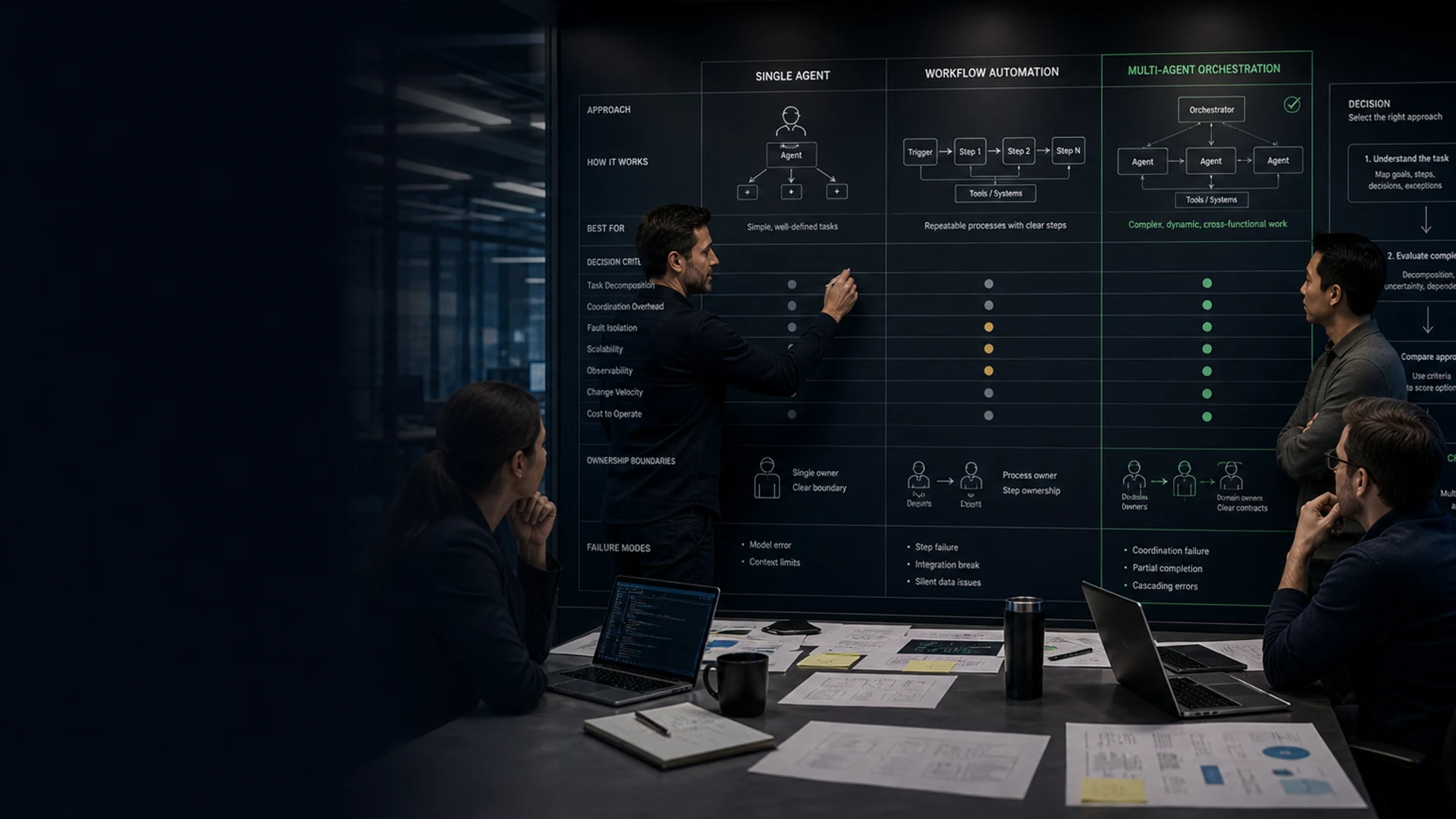
The conference circuit has settled on a narrative: the future of enterprise AI is multi-agent systems. Orchestrators, subagents, specialist roles, agent-to-agent protocols. The demos are impressive. They are also almost universally the wrong answer to the question the organization actually needs to solve.
Multi-agent is not an architecture. It is a decision that requires a specific set of conditions to be justified.
The Multi-Agent Hype Pattern
CrewAI, LangGraph, AutoGen, and a growing list of orchestration frameworks are designed to coordinate multiple agents. The implicit message from the tooling ecosystem: if one agent is useful, multiple agents are more useful. The reality: most tasks that get designed as multi-agent workflows produce better results from a single well-scoped agent with good tools, an explicit context window, and a clear definition of done.
Adding agents adds orchestration complexity. The orchestrator must distribute work, manage state across agents, handle failures at agent boundaries, collect and synthesize outputs, and maintain a coherent result despite variability in each subagent’s output. Debugging a failure in a multi-agent system requires tracing through agent boundaries where state was transformed, summarized, or lost. Every agent added to a system multiplies the debugging surface.
The question that should precede every multi-agent design: does this task have structural properties that a single agent cannot handle? If the answer is no, deploy a single agent. The sophistication is in the architecture decision, not in the number of agents.
The Three Legitimate Cases for Multiple Agents
Three structural properties justify multi-agent design. If none apply, proceed with a single agent.
Case 1: genuine parallelism. Tasks that are truly independent, with no dependency between work units, can be distributed across isolated agents running simultaneously. A single agent processing 500 leads sequentially takes five hours. Five hundred agents processing one lead each take minutes. The orchestrator distributes, the subagents process, the orchestrator collects and synthesizes. No inter-agent communication required. Each subagent receives complete, self-contained context for its unit.
Applications: prospect enrichment, page audit across a website, document classification in bulk, translation review across language pairs, contract clause extraction from a large contract corpus. The shared property: each unit of work is independent of every other unit.
Case 2: adversarial review. A second agent with a different role reviews the first agent’s output, without access to the first agent’s reasoning or intermediate steps. This is not a quality check. It is a structural property: the reviewer cannot see what the implementer saw, so it cannot rationalize the implementer’s choices. It produces fresher critique, surfaces assumptions the implementer made unconsciously, and catches reasoning errors that self-review never catches because the reviewing mind already accepts the same premises.
The pattern: an implementer agent produces output. A reviewer agent receives that output plus explicit evaluation criteria, but not the implementer’s context, plan, or intermediate steps. A resolver agent handles substantive disagreements. Enterprise applications: contract drafting plus independent clause review, architecture proposal plus independent security review, customer proposal plus independent risk assessment.
Case 3: role specialization that requires genuinely different context. A research agent needs broad access to web sources, large context windows for reading, and minimal constraints on what to retrieve. A writing agent needs brand voice guidelines, style constraints, audience specifications, and content architecture. An editing agent needs critique criteria, quality standards, and the ability to evaluate against a defined rubric. Forcing all three into a single context window degrades each function: the context required for research pollutes the focused constraints required for writing, which pollute the crisp standards required for editing.
If the three cases are not present, a single agent with well-defined tools and explicit context is the right architecture.
The Parallelism Pattern in Practice
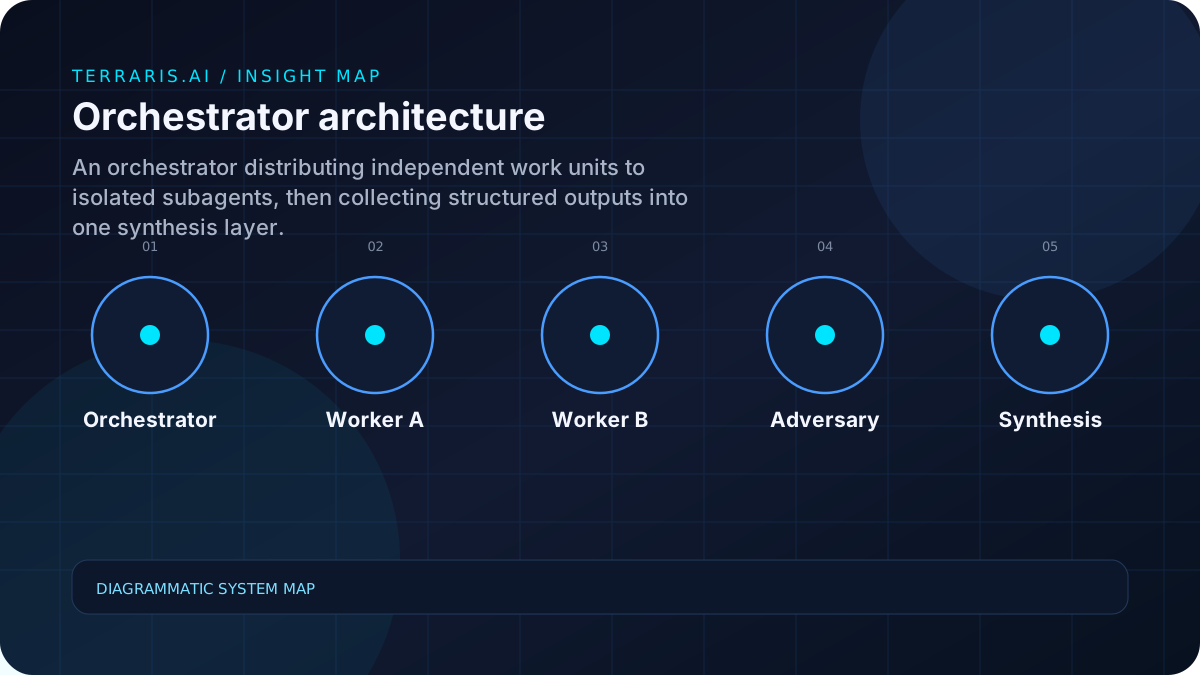
The parallelism architecture is an orchestrator-subagent pattern with strict isolation. Each subagent receives complete, self-contained context for its specific work unit. It does not communicate with other subagents. It does not access shared state. It produces output that conforms to a defined schema.
Orchestrator
├── distributes: [unit_1, unit_2, ... unit_N]
├── each subagent: receives(complete_context_for_unit_i)
│                 produces(structured_output_schema)
└── collects: [output_1, output_2, ... output_N]
             synthesizes: final_report
No inter-agent communication at the subagent level. Any coordination happens at the orchestrator level, after all subagent outputs have been collected. The orchestrator is still a single decision point.
OpenSwarm (VRSEN, MIT license) is an open-source framework for this pattern, designed around deliverable-focused swarms rather than conversational agent coordination. The GitHub repository was active with thousands of stars as of early 2026 [ESTIMATIVA: verify current stats before citing]; verify current maintenance status before adoption.
The failure mode to avoid in the parallelism pattern: subagents that share state or communicate with each other during execution. As soon as inter-agent communication is required, the units are not truly independent, and the parallelism architecture is not justified. Redesign as a sequential or graph-based orchestration.
The Adversarial Review Pattern
The adversarial review pattern works because of what the reviewer does not see. The implementer agent produces output with full access to the goal, context, constraints, and its own intermediate reasoning. The reviewer agent receives only the output, plus explicit review criteria. The reviewer has no access to the implementer’s reasoning or decision process.
This isolation matters. Self-review fails because the mind reviewing the output already accepts the same premises that produced it. An implementer who chose an architecture because of a specific constraint will not question that constraint when self-reviewing. A reviewer who never saw the constraint will question whether the architecture is appropriate. The fresh perspective is a structural property of the isolation, not a personality trait of the reviewer.
Resolver agent: handles disagreements between implementer and reviewer by analyzing both positions against stated criteria. Produces a judgment with explicit reasoning. The judgment is deterministic input to the next step.
Enterprise applications where this pattern adds measurable value: contract drafting with independent clause review (catches ambiguities the drafter normalized), customer proposals with risk review (catches commitments the sales-oriented drafter rationalized), architecture design with security review (catches assumptions the solution architect accepted), and technical analysis with independent validation (catches calculation errors and faulty premises).
Context Budget as the Multi-Agent Design Constraint
The design constraint that most multi-agent systems are built without explicitly considering: each agent has a finite context budget, and inter-agent handoffs must be explicit about what information moves between agents and in what form.
The iceberg principle: the context window contains only what must always be visible for this agent’s specific function. Everything else is accessible through tools, memory recall, or retrieval, not loaded into the context window by default. An agent that carries the full history of all previous agents’ context windows accumulates pollution at every step.
Handoff discipline: the research agent delivers structured output with sources, key findings, and explicit premissas. It does not hand off raw web content. The data analyst delivers curated tables and validated findings. It does not hand off raw query results. Each handoff is also a quality gate: the output must conform to the input specification of the receiving agent before it is passed.
Without handoff discipline, multi-agent systems amplify context pollution rather than reduce it. Each agent adds its noise to the previous agent’s noise. The final output is a synthesis of accumulated confusion.
Every handoff is also an architectural seam where errors can be introduced without being detected at the producing agent. A research agent that produces a summary with a factual error passes that error to the writing agent as ground truth. Build explicit quality checks at every handoff, not just at the final output.
The Criterion That Settles the Decision
Before designing any multi-agent system, three questions:
- Does this task have genuinely independent work units that can run in parallel?
- Does this task require adversarial review where the reviewer must not see the implementer’s reasoning?
- Does this task require genuinely different context for different functions that cannot coexist in one window?
If the honest answer to all three is no, one well-designed agent with good tools and clear context achieves the goal at lower cost, lower latency, and lower debugging complexity.
The data point that contextualizes the commercial reality: Salesforce Agentforce reached over USD 540 million in ARR with over 18,000 customers [ESTIMATIVA: verify via Salesforce earnings releases before citing]. The majority of deployed use cases in that base are single-agent or simple sequential workflows. The enterprise AI market is not primarily a market for orchestrated swarms. It is a market for reliable, scoped automation that produces auditable results.
The sophistication is in choosing the right architecture for the task. Not in deploying the most complex one.
Multi-agent is the right choice for a small set of tasks with specific structural properties. For the majority of enterprise automation problems, it is overengineering that creates maintenance burden, complicates debugging, and obscures the simple value the business actually needed.
Build the single agent correctly first. Then decide whether the task structure requires more.
For enterprise teams designing agent architectures, the AI Opportunity Sprint maps the appropriate structure for your specific use case before the build begins.