

The Chief AI Officer hire solves one problem well: the board meeting. It signals seriousness, assigns visible ownership, and gives the CEO a concrete answer to the question “who is responsible for AI in this company?” It is a coherent governance response to external pressure.
The organizational problem it creates is subtler and more consequential: it signals to every business unit that AI is a function, not a competency. The CAIO handles AI so that everyone else does not have to. If your team has an AI question, go to the CAIO.
The CAIO Signal Problem
What the CAIO hire communicates externally and what it communicates internally are structurally different.
External signal: the company is serious about AI, has dedicated senior leadership, and is investing in the capability. This is the signal the board meeting requires. It is accurate and useful.
Internal signal: AI is centralized. The CAIO’s team owns AI projects. Business units are consumers of what the CAIO’s team produces. Adoption is the CAIO’s problem to solve, using whatever leverage the CAIO has — which, in most organizations, is the leverage of persuasion rather than authority.
The structural problem follows directly: AI competency concentrated in a single function produces AI projects at the pace and influence of that function. The CAIO defines the policy, the CTO’s team builds the platform, and the business unit decides whether to use it — and commits the process access, the data, and the domain expertise required for it to work. That decision is voluntary. It is inconsistent. And the CAIO’s ability to influence it depends on organizational relationships rather than organizational design.
The companies deploying AI at scale did not centralize AI ownership in a new function. They made AI competency a condition of existing leadership performance.
Where AI Actually Gets Deployed
Every significant AI deployment in an enterprise succeeds or fails at the business unit level, not at the AI function level.
The deployment pattern is consistent: the CTO’s team builds the platform infrastructure, the CAIO’s team defines the policy and governance framework, and the business unit decides what to connect to the platform and whether the deployment is worth the process disruption. The business unit’s decision is the variable. The platform can be excellent. The policy can be well-designed. Without the business unit’s committed participation — the process access, the domain expertise, the willingness to redesign the workflow rather than layer AI on top of it — the deployment does not produce the outcome.
The critical organizational design question is not “how do we build a better AI function” but “how do we make business unit leaders accountable for AI outcomes the same way they are accountable for product outcomes and revenue outcomes?” The answer to that question does not require a CAIO. It requires changing the business review.
The Quarterly AI Cadence That Works
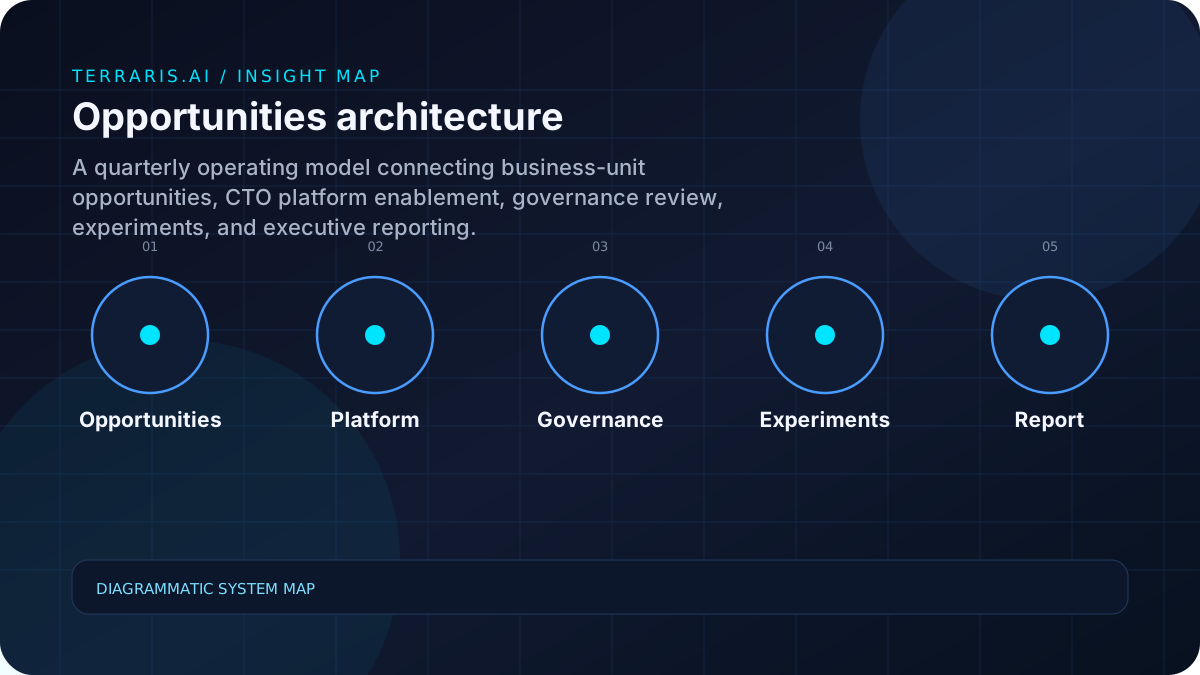
The organizational design that produces consistent AI deployment does not require a new function. It requires a cadence.
Every business unit identifies one AI opportunity per quarter using the repeatability-and-reasoning prioritization framework discussed in The AI-First Company Is Not the One with the Most Tools. The opportunity is defined with a success metric before the project starts. The experiment runs. The results are reported to the executive team.
The CTO’s role in this cadence is enabling, not directing: maintain the AI platform infrastructure, reduce the friction of starting a new experiment, review results and propagate learnings across business units. The CTO does not select which opportunities to pursue. The business unit leads do.
The CEO’s role is integrating AI accountability into the existing business review, not creating a separate AI review. When the CFO presents the quarterly financial results, the question “what AI experiment did finance run this quarter, what was the success metric, and did the metric move?” is asked with the same regularity and the same consequences for the answer as questions about budget variance and headcount.
The compound effect: twelve business units running one experiment per quarter produce forty-eight experiments per year. The organization learns faster from forty-eight experiments than any centralized AI function could direct. The learnings distribute back to the business units through the business review, not through a centralized newsletter or a mandatory training program.
The Shadow AI Problem That a CAIO Cannot Solve
Shadow AI — employees using unsanctioned AI tools on business data — is accelerating in every organization regardless of whether a CAIO exists. The CAIO’s typical response is policy-first: an approved tool list, a governance framework, a training requirement, a compliance audit.
Policy-first approaches do not solve the shadow AI problem. They create compliance theatre without addressing the underlying cause. Employees use unsanctioned tools because the sanctioned tools do not meet their needs as quickly as the unsanctioned alternatives do. The friction of the approved channel exceeds the friction of the unapproved one. Policy does not change that calculation.
The structural solution is to make the sanctioned AI tools better and faster to access than the unsanctioned alternatives. This is a platform problem, not a policy problem. It belongs to the CTO, not the CAIO.
The shadow AI map, rather than functioning as a compliance instrument, functions as a demand signal. Where are employees using unsanctioned tools? What tasks are they applying those tools to? The answers identify where the official AI platform has gaps in either capability or accessibility. The shadow AI pattern tells the CTO where to invest next in reducing the friction of legitimate AI use.
The Decisions That Actually Require C-Level AI Authority
There are genuine decisions in AI strategy that require senior leadership involvement. They are not the decisions typically assigned to a CAIO.
Risk appetite for AI autonomy: how much autonomous action can AI take on behalf of the company, in which domains, without human approval? This is a CEO and board decision. It sets the boundary conditions for every AI deployment in the organization. It cannot be delegated to a CAIO without that person having genuine organizational authority over every function’s risk posture, which most CAIOs do not have.
Data access policy: which data assets can AI systems access, under what conditions, with what logging requirements? In financial systems, this belongs to the CFO. In HR systems, to the CHRO. In customer data, to whoever owns the customer data governance framework. The CAIO can coordinate. The function owner must decide.
AI in employment decisions: whether AI can influence hiring, performance evaluation, or compensation decisions, and with what governance infrastructure. The EU AI Act’s high-risk classification covers employment AI explicitly. The CHRO owns this decision with support from the General Counsel.
Regulatory positioning: how the company will respond to EU AI Act conformity assessment requirements, AI audits from regulated clients, and procurement requests for AI governance documentation. The General Counsel owns this with input from the CTO.
None of these decisions require a CAIO. Each requires the executive who already owns the relevant domain to be informed and accountable for AI within that domain. The CAIO, if the role exists, can facilitate. It cannot substitute for function-owner accountability.
What to Do Instead
Three investments produce what the CAIO hire is intended to produce, without the organizational signal problem.
AI platform team inside the CTO function: small, focused specifically on reducing the friction for business unit AI experiments rather than on building AI projects. The platform team’s metric is not “AI systems deployed.” It is “time from AI experiment proposal to first production query.” This team is the infrastructure provider for the quarterly AI cadence.
Embedded AI leads in each major business unit: not a new headcount in most cases. An identified role for a person who already understands the function deeply and will receive training in AI system design, governance, and evaluation. The embedded AI lead is the business unit’s point of ownership for AI outcomes — the person who runs the quarterly experiment, reports results to the business review, and coordinates with the CTO’s platform team.
Business review integration: AI experiment results reviewed alongside financial results, operational results, and product results at the quarterly business review. The CEO asks the same questions about AI experiments as about product experiments: what was the hypothesis, what did you measure, what did you learn, and what is the next hypothesis? AI accountability is not a separate track. It is part of the existing governance cadence.
The test at eighteen months: is AI competency distributed across the organization’s decision-making processes, or is it still concentrated in a single function that other functions treat as optional? If the latter, the organization built an AI-adjacent company. The CAIO solved the board meeting. The organization did not change.
An AI-First company does not require a title. It requires a decision about how existing leaders make decisions.
Terraris.ai helps leadership teams build the AI operating model that distributes AI competency without creating a centralized bottleneck. Start with an AI Opportunity Sprint.