
The pattern is consistent enough to be a rule. An organization invests in a knowledge base: SharePoint, Confluence, a purpose-built internal portal. The launch generates initial enthusiasm. Adoption peaks in the first six weeks. By month six, a small fraction of intended users access it regularly. The organization diagnoses the problem as poor search quality, outdated content, or insufficient training.
None of those diagnoses are wrong. All of them are downstream of the actual problem.
The knowledge base requires the employee to stop what they are doing, switch to the knowledge system, formulate a search query, evaluate the results, and return to the original workflow. That is four context switches for information needed at a specific moment in a specific task. The cognitive cost compounds with frequency. Practitioners learn to work around the knowledge system rather than through it.
Knowledge systems fail at adoption because they are designed as libraries. The question is not how to make the library better. The question is why the knowledge needs to be in a library at all.
The Adoption Graveyard
Enterprise organizations have been building knowledge bases for thirty years. The outcomes are documented well enough to draw conclusions. The consistent finding across industries and tool generations: adoption peaks at launch and decays to a fraction of intended use within six months. The percentage that survives varies by organization and by how critical the knowledge is to daily work, but the decay curve is reliable.
The diagnoses that organizations reach when they audit the adoption failure tend to cluster around three explanations: the content is out of date, the search is poor, or employees were not trained adequately. All three are real, all three are addressable, and fixing all three rarely changes the adoption trajectory in a meaningful way.
The actual mechanism is simpler and harder to fix with features. Knowledge is consumed at the moment of decision. The support agent answering a customer query needs product knowledge at the moment of the query, not after the call. The account manager preparing a proposal needs precedent examples at the moment of drafting. The field technician diagnosing a problem needs the relevant procedure at the moment of diagnosis.
A knowledge system that requires a workflow interruption to access is competing against the path of least resistance: asking a colleague, trusting memory, or skipping the lookup entirely. In that competition, the library loses to the nearest human every time.
The Workflow Integration Principle
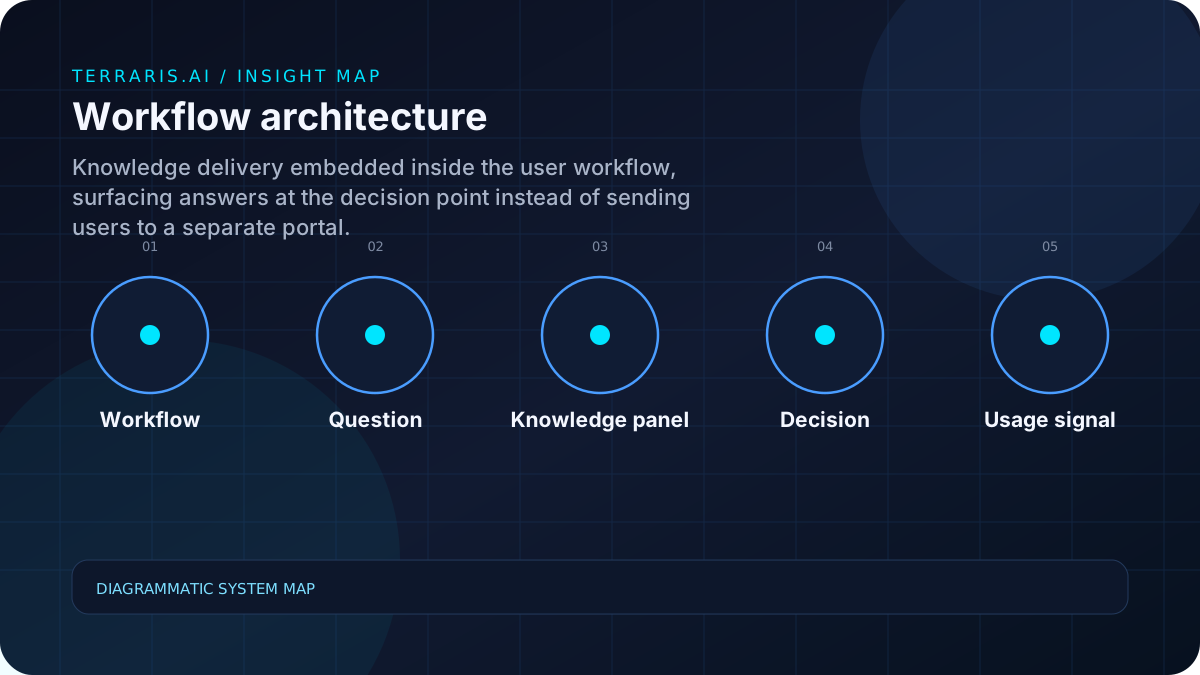
Workflow integration is not a UX improvement. It is a different design premise.
The design question is not “how do we make the knowledge base easier to search?” It is “where in the workflow does the question arise, and can we surface the answer there?”
The difference is concrete. A customer support agent using a CRM where the relevant knowledge article appears in a sidebar when a query type is detected does not need to visit a knowledge base. The knowledge is present in the workflow. The agent’s choices are “use this” or “ignore this,” not “remember to search for this.”
The AI-enabled version of workflow integration is a RAG system embedded in the tools where work actually happens: the support platform, the CRM, the document drafting environment, the code editor. The system detects the context of the current task and surfaces relevant information without requiring an explicit query. The user does not need to know the knowledge base exists. They receive the relevant knowledge as a feature of the tool they are already using.
The adoption metric changes accordingly. The right measure for a workflow-integrated knowledge system is not page views on the knowledge portal. It is whether the system is consulted at the moment of need. That metric requires instrumentation at the point of decision, not analytics on the knowledge platform.
For organizations building AI-First knowledge systems, this means the integration layer is not optional. A knowledge system that is not integrated into the tools where decisions happen will follow the same adoption curve as every previous knowledge initiative, regardless of how well the indexing is done.
The Content Freshness Problem
A knowledge base that is technically accessible but factually stale is worse than no knowledge base. It produces confident wrong answers. The system presents a plausible response, the user accepts it, and the error propagates into a decision.
The freshness failure modes are consistent. Documentation describes a process that was changed months ago and nobody updated the knowledge base. A policy document references a regulatory requirement that has been superseded, but the document remains in the index with a high relevance score. A contract template cites terms that the legal team stopped using after a specific incident, but the template is still the top result for the relevant query.
For AI-powered knowledge systems, stale content is an amplification risk. A retrieval system surfaces the stale document with high confidence. The generation layer produces a fluent, specific, plausible answer based on it. The user has no signal that the document is outdated. The error is delivered with more authority than a human citing from memory would have.
The solution is metadata-first ingestion. Every document in the knowledge system carries a valid-as-of date and an assigned owner. The owner is responsible for reviewing the document when the valid date passes. Automated staleness alerts trigger when a document has not been reviewed within its validity period. Documents past their validity date are flagged in retrieval results or suppressed pending review.
This is treating knowledge content like software dependencies: scheduled updates, not emergency patches. The operational discipline required is identical to keeping dependencies current in a production system. The cost of letting dependencies age is also identical: silent failures that surface at the worst possible moment.
The Tribal Knowledge Extraction Problem
The most valuable knowledge in most organizations is not in the knowledge base because it was never written down.
It exists in the heads of practitioners. The workarounds that everyone applies but no procedure documents because the procedure was written before the workaround existed. The undocumented exceptions that an experienced operator applies automatically. The context about a client relationship that explains why a standard approach does not apply to this specific account.
This knowledge is extractable, but it requires a different method than document indexing. Structured expert interviews focused on exceptions and edge cases, not on the procedures already documented. Process shadowing: observing how practitioners actually perform a task rather than asking them to describe it. Annotation of edge cases as they occur rather than after the fact. Decision logs that capture rationale alongside outcomes.
The extraction workflow that consistently produces usable outputs: identify the five highest-value knowledge holders in a domain. Conduct structured thirty-minute interviews focused on two questions: what would a new person do in this process that you would immediately recognize as wrong, and what is the most expensive mistake you have seen someone make that better knowledge would have prevented? Capture the responses in a structured format that maps directly to the knowledge system’s schema.
The cost of not extracting this knowledge is the attrition cost multiplied by however many departures go unmanaged. Every time a domain expert leaves without a knowledge capture effort, a portion of the operational intelligence that made the organization capable leaves with them. New staff make avoidable mistakes. AI systems deployed without this knowledge produce outputs that experienced practitioners immediately recognize as missing the context that matters.
The Query Type Mismatch
Most knowledge systems are built for one query type: find a document that contains X. The most valuable queries in most organizations are different.
Reasoning queries require synthesis, not retrieval. “Given these constraints, what should we do?” does not have a document that answers it. It requires combining evidence from multiple sources, applying judgment about tradeoffs, and producing a recommendation. A retrieval system surfaces the relevant documents. The reasoning layer generates the recommendation. The two are different components of the system, and conflating them produces systems that fail on the queries where the value is highest.
Absence queries require knowing what is not in the corpus. “Is there any precedent for this decision?” must return a reliable null result when there is none. A system that generates a plausible-sounding answer when no relevant precedent exists is more dangerous than one that returns no results. Absence handling requires explicit design: the system must be capable of distinguishing “no relevant documents retrieved” from “I should generate something anyway.”
Relational queries require a people and expertise graph. “Who knows about X and what is their recommendation?” is not a document retrieval problem. It is a graph traversal problem. The answer requires knowing which people are connected to which domains, what their level of expertise is, and what recommendations they have made in similar contexts. A document index does not answer this. A relational map does.
Temporal queries require versioned content. “What was the policy before the 2024 change?” requires that the knowledge system retains historical versions of documents and can surface the right version for the specified time period. A flat index that contains only the current version of each document cannot answer temporal queries reliably.
The implication for system design is that the first step is not choosing a technology. It is mapping the actual query types that arise in the target workflow and designing the architecture to handle each. Most enterprise knowledge failures are query-architecture mismatches, not search engine failures.
The Metric That Predicts Survival
The right metric for an enterprise knowledge system is not documents indexed, search queries executed, or monthly active users on the knowledge portal. It is decisions improved.
A knowledge system survives long-term if practitioners can point to specific decisions they made better because the system gave them accurate, relevant information at the moment they needed it. Not better search results. Better decisions. The distinction is what the system is actually for.
If practitioners cannot cite such a decision within the first sixty days of deployment, the system is on the path to the adoption graveyard regardless of its technical quality. This is the adoption graveyard test: it does not measure what the system can do; it measures whether practitioners are using it to do something that matters.
The implication for design and deployment is sequencing. Before building, identify three specific decisions the system will improve. Define what “improved” means for each: faster, less error-prone, better-informed, more consistent. Use those three decisions as the acceptance criteria for the first deployment. If the system does not improve those three decisions in the first sixty days, the deployment is failing regardless of what the usage analytics show.
This is a harder standard to meet than documents indexed. It is also the only standard that corresponds to why the system was built in the first place.
The gap between a knowledge system that indices well and one that practitioners actually use is a design problem, not a content problem. Terraris.ai works with enterprises to design knowledge systems that sit inside workflows, not alongside them.