

There is a gap between what a general-purpose AI tool does in the demo and what it does in month three of production. Most enterprise AI projects encounter that gap and call it a technology problem. It is a domain problem.
A generic LLM carries the breadth of the internet and not enough of your business. It does not know your contracts, your terminology, your regulatory constraints, your historical decisions, or the edge cases your team has learned to handle by instinct. It will generate confident output in all of these areas, and much of that output will be wrong in ways that are hard to detect without domain expertise.
Vertical AI solves a different problem. It is not a tool that can discuss anything. It is a system that knows this process, this corpus, this decision well enough to be trusted.
The Generic AI Trap
The failure mode is predictable. A team deploys a general-purpose assistant. Early results are impressive: it summarizes documents, drafts emails, answers broad questions. The team declares success. Then the use cases get specific. A contract clause with jurisdiction-specific nuance. A customer query requiring product knowledge three layers deep. A compliance decision that depends on internal policy documents the model has never seen.
The generic model fails, or worse, it answers confidently with something plausible but wrong.
The gap between demo and production is exactly the domain knowledge that a generic model does not have. That gap does not close by switching to a better foundation model. It closes by investing in what goes into the context window and how that context is assembled.
What Makes AI Vertical
Vertical AI has three structural components that generic AI lacks.
The first is domain context: industry-specific knowledge, regulatory environment, specialized terminology, and the corpus of prior decisions that constitutes institutional memory. A legal AI trained on generic text does not know your jurisdiction’s case law. A manufacturing AI without access to your equipment specifications cannot reason about your maintenance cycles.
The second is proprietary data: internal documents, transaction records, historical decisions, customer interactions. This is the knowledge that exists nowhere else. No foundation model has it. No competitor can retrieve it without access to your systems.
The third is process integration: the system is connected to the actual workflows where decisions happen, not a standalone chatbot that requires copy-paste to be useful. Context assembled from a live workflow is more precise than context assembled from a static document dump.
Generic AI has none of these. Well-implemented vertical AI has all three.
The central insight is that vertical AI is not primarily a model choice. It is a context architecture choice. The model gets smarter about your domain as you invest in what you put in its context window and how you structure retrieval against your proprietary corpus.
The Moat Is Not the Model
Foundation models are commodities. Every company in your industry has access to the same GPT-4, Claude, Gemini. The model is not your advantage.
The moat in vertical AI is the data, the domain expertise that shaped the context architecture, the integration with proprietary systems, and the governance that makes the system trustworthy in regulated environments. None of these are replicable without access to your domain and your processes.
This is why switching costs accumulate in vertical AI in a way they do not in generic AI. A system embedded in a workflow, with customized retrieval against your document corpus, tested outputs, and a working audit trail, is not easy to replace. Not because of technical lock-in. Because the organizational learning encoded in the system takes time to rebuild.
The implication is direct: the investment priority for AI-First organizations is not chasing the next model release. It is building the context quality, evaluation discipline, and process integration that make a specific model genuinely useful for a specific job.
The Niche Selection Framework
Not all niches support vertical AI equally. The right vertical has five properties.
High process repetition: the system handles the same class of decision many times, which means evaluation data accumulates and edge cases become predictable. Single-occurrence judgments do not benefit from AI the same way.
Significant judgment at decision points: if the process is pure rule application, traditional automation handles it more reliably than an LLM. Vertical AI is best where human expertise has been the differentiator.
Available document or data corpus: the system needs something to retrieve from. If the domain knowledge lives in the heads of three people who have never written it down, retrieval-augmented generation cannot help.
Clear success metrics: you must be able to measure whether the AI output was correct. Domains with subjective outcomes or no ground truth cannot build the evaluation harness that separates good AI systems from expensive guesses.
Regulatory or quality pressure: industries where errors are costly create the conditions for serious vertical AI investment. Generic tools are not trusted in these environments; well-governed vertical systems can earn that trust.
A practical filter before any vertical AI project: is someone already spending money today to solve this problem? Staff time, external consultants, manual processes that scale with headcount. If yes, the problem is validated. If no, investigate why AI is the first solution being proposed.
Industries where vertical AI has demonstrated production traction include legal document review, financial compliance monitoring, agricultural process optimization, manufacturing quality control, and enterprise customer support requiring deep product knowledge. What these have in common is not the industry. It is that all five properties above are present.
The Implementation Stack
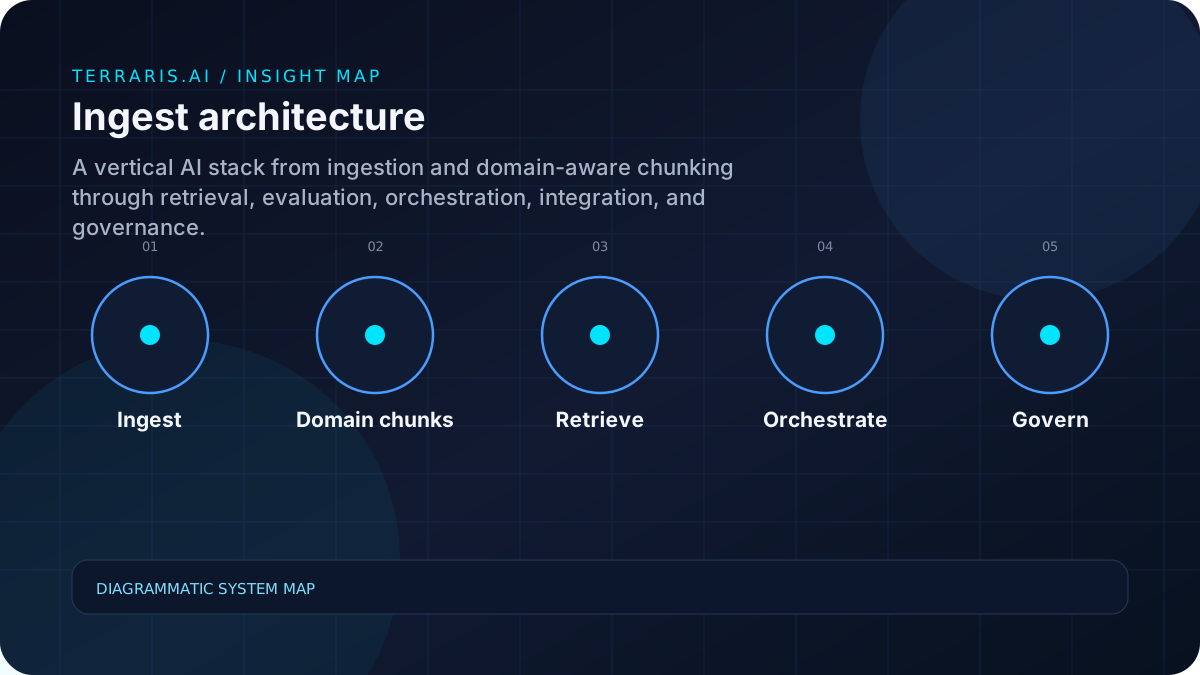
Vertical AI systems are built in layers, and each layer determines the ceiling of every layer above it.
The ingestion layer handles parsing and structuring raw documents, PDFs, structured records, and knowledge bases. Domain-aware chunking matters here: splitting a contract at paragraph boundaries preserves clause integrity in a way that character-count chunking does not.
The retrieval layer sits above ingestion. Hybrid search, combining vector similarity with keyword matching, outperforms pure vector search in domains with specific terminology. Entity extraction that knows domain terms improves recall on queries that use those terms precisely.
The context assembly layer decides what goes into the prompt for a given query and a given user. This is not document dumping. It is precise assembly of the most relevant chunks, filtered by the user’s permission model and the query’s specificity.
The governance layer defines human review gates for high-stakes outputs, maintains audit logs, and aligns permissions with existing data access controls. In regulated environments, this layer is not optional and not reducable to a checkbox.
The evaluation layer tests the system against domain-specific criteria, not generic benchmarks. The eval harness is built from real cases with known correct answers, contributed by subject-matter experts who own the domain.
Poor ingestion degrades everything above it. An evaluation harness that does not reflect real cases gives false confidence. These are not AI problems. They are software engineering and data quality problems that happen in the context of AI systems.
Starting Narrow and Expanding
The go-to-market pattern for vertical AI is not industry-wide coverage. It is a specific process that works reliably in production.
A legal AI does not start by replacing all legal work. It starts by accelerating one document review workflow where the quality bar is definable, the corpus is available, and a subject-matter expert can validate output. Once that works, and the evaluation harness is built, and the team knows what good looks like, expanding to adjacent workflows is a disciplined extension rather than a fresh bet.
The expansion logic compounds. Each solved problem produces evaluation data, process knowledge, and integration depth that makes the next problem cheaper to solve. This is the structural advantage of narrowness over breadth: a vertical AI system that starts narrow and expands deliberately is more defensible than one that starts broad and tries to specialize later.
The most dangerous AI strategy in any vertical is trying to be vertically general, claiming expertise in an industry without the data depth or integration to back it up. That strategy produces impressive demos and ghost-town deployments.
The systems that earn trust in production are built the other way: one solved problem, instrumented well, expanded only when the first problem is stable.
Building a vertical AI system for your industry? The first question is not which model to use. It is where your domain knowledge lives and whether your retrieval architecture can surface it precisely.
Related: The Discovery Sprint That Prevents Twelve-Month Vertical AI Mistakes and Your Industry Does Not Need an AI Platform