
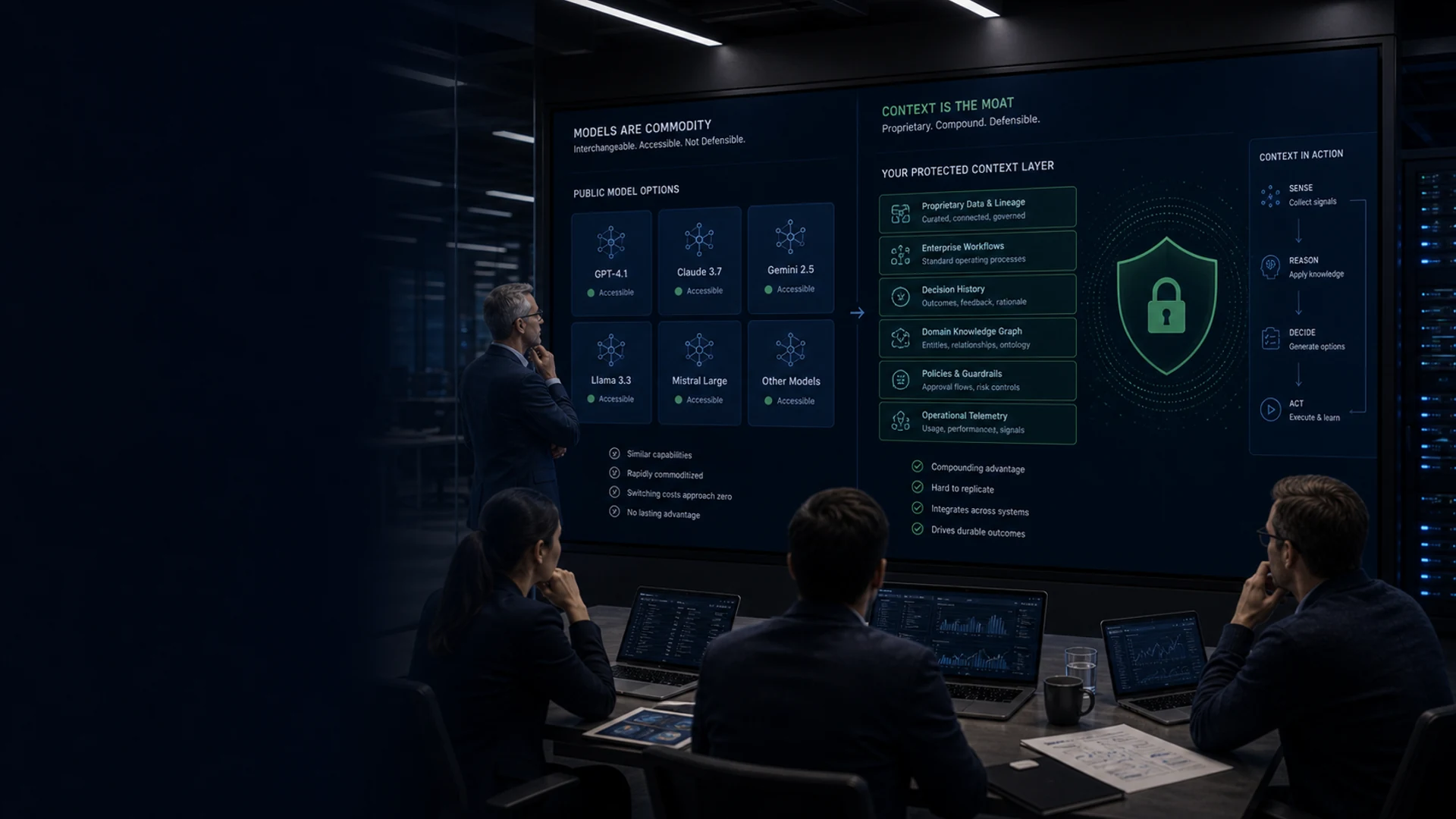
The benchmark race is settled. GPT-5, Claude, Gemini — all of them perform above the threshold for most enterprise tasks, and all of them are accessible at similar price points through an API call. The strategic question is no longer which model you use. It is what surrounds the model.
Organizations that built AI strategies around being early adopters of a specific frontier model are now discovering the problem: capability advantages measured in months evaporate with each new release. The organizations that built the context layer first are discovering something different. Their advantage compounds.
The Capability Curve Has Flattened for Buyers
The gap between frontier models and second-tier alternatives has narrowed materially for most business tasks. More consequentially, every organization accesses frontier capability through identical pricing structures. There is no moat in the model selection.
This was predictable from the economics. Anthropic, OpenAI, and Google each invest billions in compute before knowing demand, absorb the cost of successive model generations, and price access affordably enough to prevent large enterprises from fine-tuning open-source alternatives instead. The pricing pressure is structural. The frontier will remain accessible.
Dario Amodei has described the underlying bet as one of capability compounding at scale — if models become capable enough to perform economically valuable work autonomously, the value created exceeds the compute cost by orders of magnitude. That framing matters for enterprise buyers: the bottleneck is not model capability. The bottleneck is organizational readiness to use it.
The implication for strategy: any competitive position predicated on model advantage has an expiration date measured in months. The permanent differentiator is what the model operates on — the context, the data, the integration, and the organizational capability to improve them over time.
What Context Engineering Actually Is
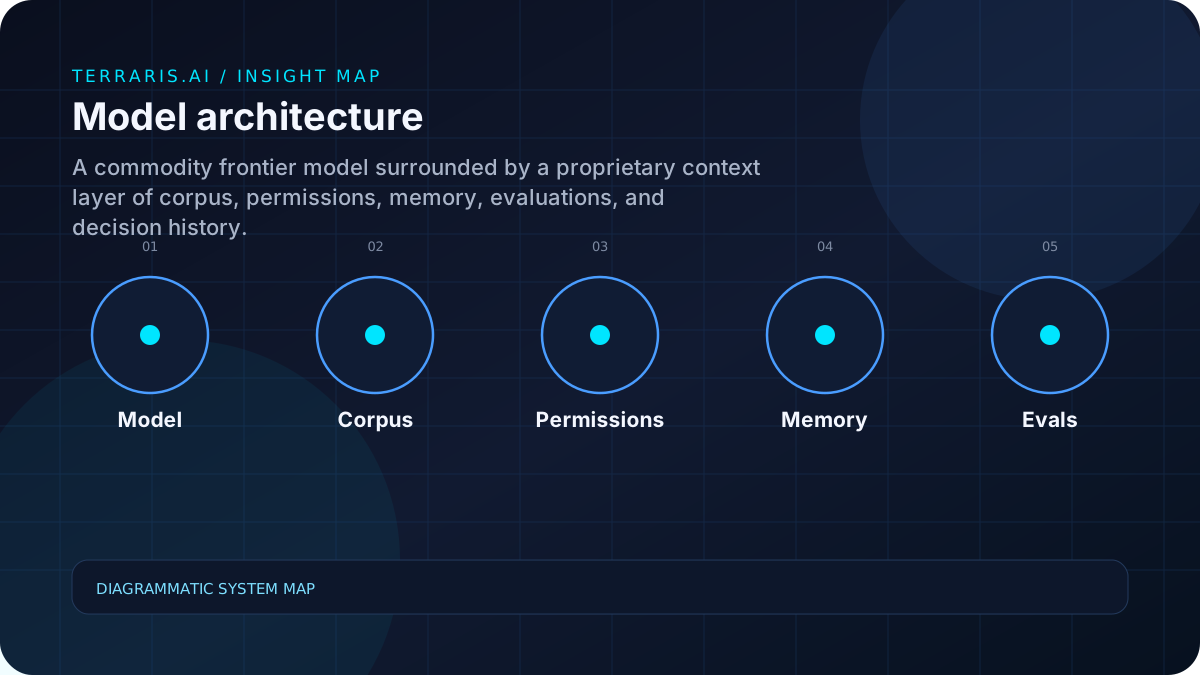
A frontier model without context knows everything the internet contained and nothing specific about your organization. The same model with well-engineered context knows your contracts, your processes, your customer terminology, your regulatory constraints, and your decision history. That difference is not a function of the model. It is a function of the work done on the context layer.
Context engineering is the discipline of deciding what information enters the model’s context window, in what form, when, and for whom. The components of an enterprise context layer are not complicated to enumerate, but they require sustained investment to build well:
- Proprietary document corpus — ingested, cleaned, version-controlled, access-controlled, and updated as the source of truth changes.
- Structured data feeds from internal systems — ERP, CRM, contracts, financial records — connected with change management so the AI system does not operate on stale data.
- Institutional memory — decision records, lessons learned, historical context that does not live in any single document.
- Permission model — specifying which roles can access which context, preventing the AI layer from surfacing information to users who should not have it.
- Tool definitions — the explicit catalog of actions the model can take on behalf of users, scoped to the current use case.
The investment insight is straightforward: every dollar invested in corpus quality compounds. A well-structured document set today produces better retrieval results tomorrow as both the model and the retrieval architecture improve. The same corpus, better exploited, produces progressively better outputs over time without additional data investment.
The Frontier Economics of Model Providers
The structural tension in frontier model economics creates a durable opportunity for enterprise buyers. Providers must front capital at scale before demand materializes, absorb the cost of model updates across a customer base that pays recurring fees, and maintain pricing low enough to discourage self-hosting of open-source alternatives.
For buyers, this tension means that frontier model capabilities will continue improving faster than most organizations can consume them with appropriate governance. The bottleneck is not on the supply side. Organizations that build the context infrastructure now position themselves to capture value from each successive model generation without rebuilding the foundation. The infrastructure is already in place.
The competitive advantage does not come from being first to access a new model. It comes from having the infrastructure that makes any model more effective for your specific work.
This is not a subtle point. It reframes the AI investment question entirely. The question is not “which model should we use” — that decision is largely commoditized. The question is “what context layer can we build that no competitor can replicate, even if they use identical models.”
The Open-Source Pressure
Open-source alternatives — Llama, Mistral, Qwen — apply cost pressure to frontier model pricing while simultaneously raising the floor of what is available without API fees. This is not a threat to the context layer argument. It reinforces it.
Self-hosted open-source models are viable for specific enterprise use cases: data residency requirements that prohibit sending data to external APIs, query volumes where API economics become prohibitive, or tasks that do not require frontier-level reasoning. The architecturally sound decision is a hybrid model stack, not a binary choice.
Frontier models serve high-stakes, complex reasoning tasks where quality justifies the cost. Fine-tuned or quantized open-source models serve high-volume, lower-complexity tasks where cost efficiency matters more than capability ceiling. The governance implication is real: self-hosted models require on-premise infrastructure, security hardening, and update management that API models do not. The apparent cost saving must be evaluated against the operational overhead, and that calculation changes as internal teams grow or shrink.
What does not change: the context layer is valuable regardless of which model accesses it. A corpus built for a frontier API model is equally accessible to a self-hosted alternative. The moat is not model-specific.
Regulation as a Frontier Economics Variable
Frontier model capability has become a variable in geopolitical and regulatory decision-making. Export controls on advanced AI chips constrain where certain capabilities can be developed. The EU AI Act’s risk classifications determine which use cases require conformity assessment regardless of the model powering them. National AI strategies influence procurement in markets where government contracts matter.
The practical consequence for enterprise AI architects: model selection is increasingly a compliance question alongside a capability question. A frontier model that cannot be deployed in a specific jurisdiction for a specific use case — because the use case involves employment decisions, credit scoring, or critical infrastructure under the EU AI Act’s high-risk classifications — is not a frontier model for that purpose.
The sovereign AI trend compounds this. Several large markets are investing in national foundation models. Organizations operating in those markets may face procurement policies or data localization requirements that narrow the model selection independently of capability comparisons. The context layer built on appropriate infrastructure retains value under any of these scenarios. The model selection remains variable.
Where the Competitive Advantage Accumulates
The organizations winning with AI in 2026 are not watching benchmark leaderboards. They are building infrastructure.
Three advantages accumulate over time:
Corpus quality — proprietary data that competitors cannot replicate, even if they use identical models and identical architectures. The organizational knowledge embedded in a well-maintained document corpus is not purchasable. It takes time and operational discipline to build.
Eval harness maturity — a testing infrastructure that detects quality changes before users do. Organizations that built this in 2025 now have a baseline against which every model update and every corpus change is automatically tested. Organizations that did not are discovering failures in production.
Integration depth — the AI layer embedded in actual workflows, not sitting alongside them. The difference between an AI tool an employee opens in a separate browser tab and an AI capability that runs inside the process the employee is already in is the difference between optional adoption and structural advantage.
None of these advantages appear on a benchmark. They appear in production, in the quality of outputs, in the speed of improvement, and in the governance maturity that allows progressively higher-stakes automation over time.
The model is a commodity because every organization can access it. The context is the moat because only you built it — and because building it takes longer than any model release cycle.
Terraris.ai helps regulated enterprises build context layers that compound. If you are mapping your AI-First architecture, start with a sprint.