
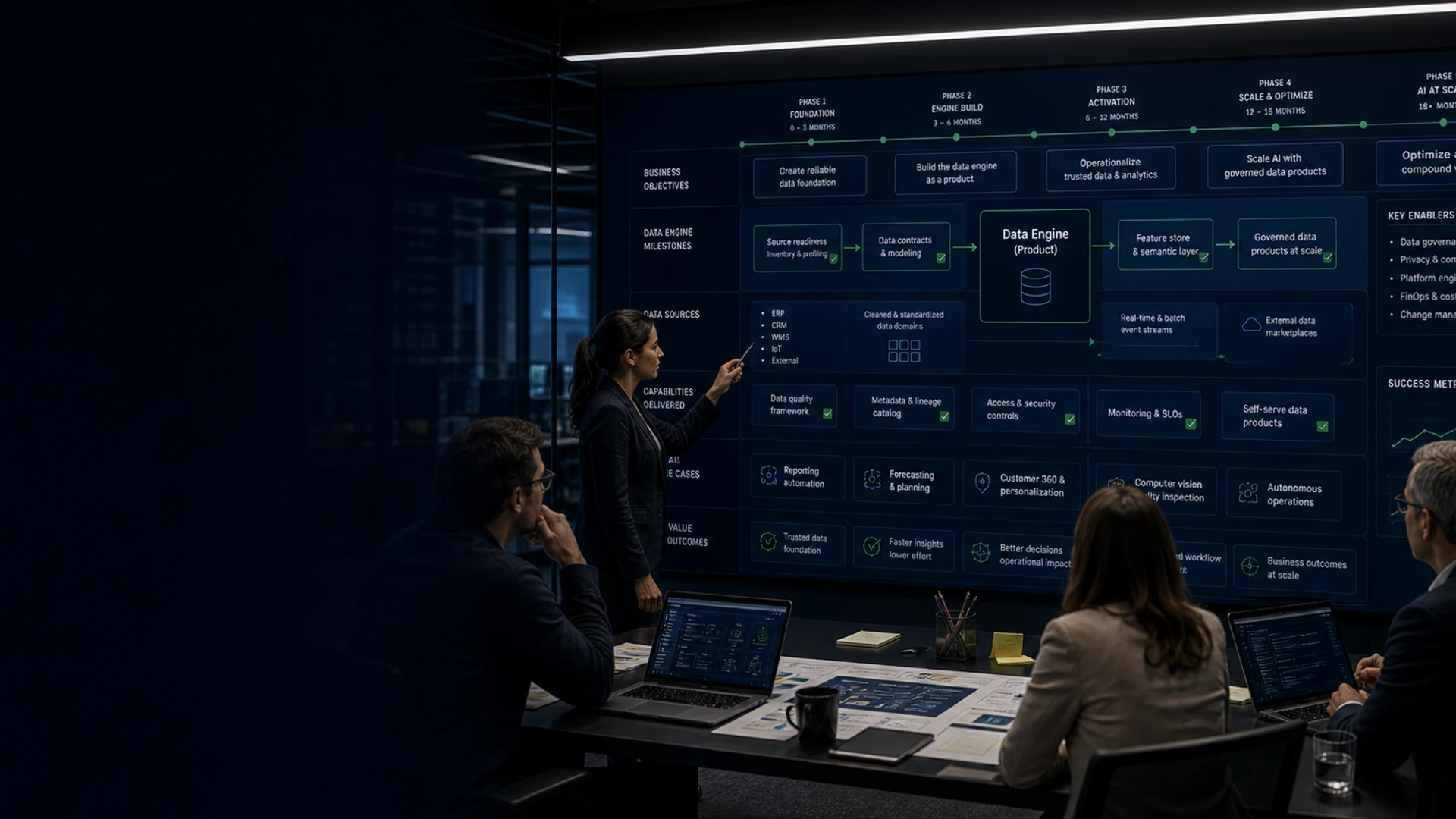
Six months after deploying an AI system without a feedback loop, the typical enterprise has a problem it cannot name. The system still runs. Users still query it. But the outputs that were impressive at launch are now, quietly, less reliable. Edge cases accumulated. The corpus drifted from the ground truth. Nobody noticed because nobody was watching.
This is not a model problem. It is a data engine problem — specifically, the absence of one.
The Data Engine Is Not About Big Data
The data engine concept is frequently misread as a big-data story: to apply it, you need massive datasets, a dedicated data science team, and GPU infrastructure for retraining. That reading misses the original framing entirely.
Andrej Karpathy introduced the data engine concept in the context of Tesla’s autonomous driving program: deploy, observe failures, mine hard cases, reconstruct ground truth, clean data, retrain, redeploy. The loop is the point, not the scale. The insight is that systematic improvement requires a structured feedback cycle between production behavior and the data that trains or augments the system.
The enterprise translation does not require retraining a foundation model. It requires building the feedback loop that makes your AI system improve with use instead of degrading with it.
The difference between an AI system with a data engine and one without is visible at six months: the first is more accurate on your specific use cases because the production failures were systematically addressed. The second is less accurate because edge cases accumulated without correction, the corpus diverged from current operational reality, and nobody had a mechanism to detect or fix either.
The Four Steps of the Enterprise Data Engine
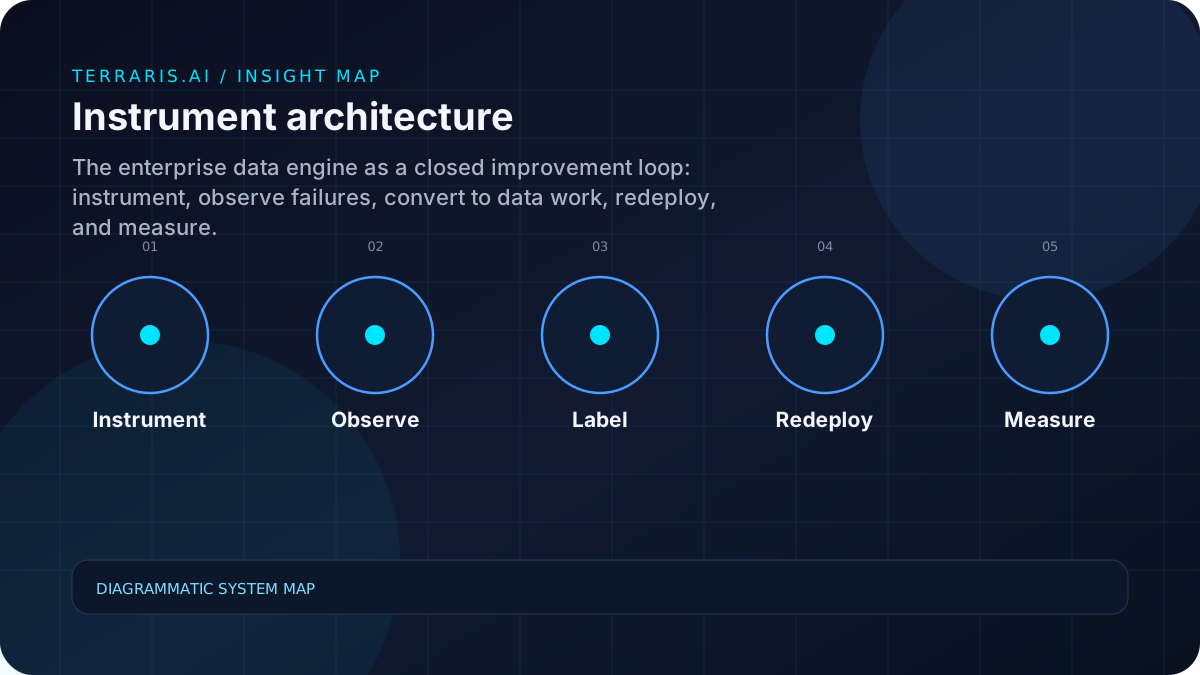
The enterprise data engine has four steps. None requires a machine learning team. All require operational discipline.
Step one: deploy with instrumentation. Every query, every retrieved document chunk, every generated output, every human correction is logged. Not sampled — logged. This is the raw material of the engine. Without it, the subsequent steps have nothing to work with. Most enterprise AI deployments skip this step because it feels like overhead at launch. It is, instead, the foundation of every improvement that follows.
Step two: observe failure modes. Review the logs systematically. Not anecdotally, not reactively after a user complaint. Categorize failures by type: retrieval gap (the answer existed but was not found), hallucination (the system invented information not in the retrieved context), entity resolution failure (two different entities conflated), out-of-scope confident answer (a question outside the corpus answered with false certainty). Quantify each category. The distribution matters as much as the existence.
Step three: mine hard cases. Extract the failures from production and add them to the evaluation harness. These are the cases the system handles worst and is most likely to encounter again, because they reflect the actual distribution of user queries, not the clean test cases used during development. A hard case in production is more valuable than a hundred synthetic test cases that the system already handles well.
Step four: rebuild and improve. Address the top failure category with a targeted fix: an ingestion update, a chunking strategy change, a prompt modification, a new document added to the corpus, a retrieval parameter adjustment. Run the eval harness before and after the fix. Verify that the targeted failure category improved without introducing regressions in cases the system previously handled correctly.
The cycle time in a well-managed enterprise AI system is monthly. Faster is better, as long as regression testing keeps pace with the improvement cadence.
The Failure Taxonomy That Drives Improvement
Not all AI failures have the same cause or the same remedy. Treating them as equivalent wastes the improvement budget. The failure taxonomy is the diagnostic instrument.
Retrieval gap: the answer exists in the corpus but was not retrieved. The cause is usually chunking strategy — documents split at the wrong boundaries, metadata insufficient for filtering, or retrieval parameters set for recall over precision when the use case requires the inverse. The remedy is ingestion review, not model change.
Hallucination: the system generated information not present in the retrieved context. The cause is usually insufficient grounding in the prompt, a model operating beyond its retrieved evidence, or a query that required synthesis across documents the retrieval layer did not surface together. The remedy is prompt reinforcement of citation requirements, stricter grounding instructions, or retrieval architecture review.
Entity resolution failure: two distinct entities were conflated — two people with similar names, two products with overlapping descriptions, two contracts with similar parties. The cause is ambiguous entity representation in the corpus. The remedy is explicit entity disambiguation at the ingestion layer, not at query time.
Out-of-scope confident answer: the system answered a question outside its corpus domain with apparent certainty. This is a boundary failure — the system does not know what it does not know. The remedy is explicit scope boundary prompting, a classification layer that identifies out-of-scope queries before generation, and a “cannot answer” response path that is designed, not improvised.
The taxonomy converts a problem that looks like “the AI system is unreliable” into a set of specific, addressable failure modes with specific remedies. It is also the basis for the improvement roadmap: the most prevalent failure category in the current failure distribution gets the next improvement sprint.
The Human-in-the-Loop as Data Engine Component
Human review is not overhead in an AI system. It is the primary source of high-quality improvement signal.
Every human correction is a labeled example: the query, the system output that was wrong, and the correct answer. This is structurally more valuable than any synthetic dataset because it reflects the actual distribution of real user queries on real enterprise data. Synthetic test data reflects what the development team imagined users would ask. Production corrections reflect what users actually asked and what the system actually failed to answer correctly.
The minimum viable human review loop: one domain expert reviews a sample of AI outputs weekly. The sample is not random, it is biased toward the edge cases identified in step two — the queries the system is statistically most likely to get wrong. The corrections are structured: not just “approved/rejected” but “what was wrong and what is correct.” The structured correction routes to the appropriate fix layer in the next improvement sprint.
The volume required is not large. A data engine does not require reviewing every output. It requires reviewing enough outputs to characterize the current failure distribution and prioritize remediation. For most enterprise AI systems in their first year of production, that is tens of corrections per week, not thousands.
Thomson Reuters acquired Casetext, a legal AI company, for US$650 million in 2023. The stated rationale included the quality of Casetext’s AI outputs on complex legal research tasks. That quality was not intrinsic to the model; it was the product of years of feedback cycles between the AI system and practicing attorneys. The data engine, not the model, was the asset.
The Roadmap Implication
An AI roadmap built on data engine principles looks different from a feature roadmap.
A feature roadmap adds capabilities sequentially: RAG system first, agents second, automation third, integration fourth. It measures success by feature completeness. The implicit assumption is that more capability equals more value.
A data engine roadmap starts narrow, instruments everything, and improves quality on the initial use case before expanding. It uses the failure taxonomy to prioritize the next capability: if the primary failure mode of the current system is retrieval gap, the next investment is corpus quality, not agent architecture. It measures success by output quality on defined benchmarks against a stable baseline.
The expansion rule is direct: do not add a new AI capability until the existing capability has a stable eval harness and a functional improvement cycle. Adding capabilities to an unmonitored base creates compounding quality debt. Each new capability introduced before the previous one is governed adds another layer of potential failure that is invisible until it surfaces in production.
The budget implication follows: AI investment proposals should include instrumentation costs (logging infrastructure, observability tooling, eval harness setup) and improvement cadence costs (monthly review cycles, correction workflow, domain expert time) as first-class line items. These are not overhead — they are the mechanism that converts a one-time deployment cost into a compounding capital asset.
The Compounding Return
AI systems without a data engine are consumer products. AI systems with a data engine are capital assets.
A consumer product is used until a better version replaces it. The value extracted is proportional to the time the product is in use. A capital asset appreciates with investment and produces compounding returns over time.
The organization that builds a data engine for its AI systems in 2026 will have, in 2028, a system calibrated on two years of real production data, a failure taxonomy built on actual usage patterns, and an eval harness that detects regressions before users encounter them. None of that is acquirable by buying a newer model. A competitor who purchases the same frontier model in 2028 starts the data engine cycle at month zero.
The first step is not building the data engine. It is instrumenting the first AI system completely enough that the data engine has raw material to work with. Logging is not optional infrastructure. It is the prerequisite for everything that follows.
Terraris.ai designs AI roadmaps built on data engine principles, from instrumentation architecture to monthly improvement cadence. Start with an AI Opportunity Sprint.